What We Want, What We Believe (1966)

1946-1989, Authority, Black, Consciousness Raising, Date, Defining the Enemy, Disruptive Spaces, Imperialism, Institutions, Sabotage/Ecotage, Strike, Subjectives of Refusal, Tactics of Disruption, White Supremacy

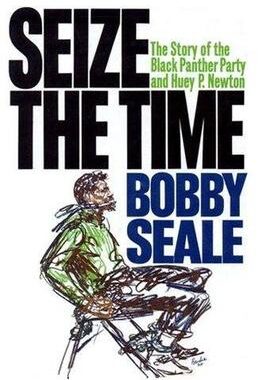
The Black Panther Party’s 10 Point Program, or formally, “What We Want, What We Believe,” served as a set of demands drafted by Huey P. Newton and Bobby Seale. This program/document served as the founding document and primary list of grievances posited by the Black Panther Party. It had many calls to action for societal change. These included, but were not limited to: a call for educational reform, housing reform, reform of the judicial process, and reform of employment biases. This served as an extremely disruptive foundational document, primarily through points 7 through 10 in their violent calls to take up arms. In these points, the Black Panther Party was calling for a disruption of the previously established authority. They advocated for their followers to take up arms and occupy public spaces in order to become monitors of freedom and independence for the Black community. In short, this was a manifesto charged with creating uncivil disobedience to ensure a more responsive, more representative society for the Black communities.

We want land, bread, housing, education, clothing, justice and peace. And as our major political objective, a United Nations-supervised plebiscite to be held throughout the black colony in which only black colonial subjects will be allowed to participate, for the purpose of determining the will of black people as to their national destiny.

An Unladylike Strike FashionablyClothed: Mexicana and AngloWomen Garment WorkersAgainst Tex-Son, 1959–1963

1946-1989, Authority, Colonized, Consciousness Raising, Date, Defining the Enemy, Disruptive Spaces, Latino, Patriarchy, Strike, Subjectives of Refusal, Tactics of Disruption, The Home, The Workplace, Women, Workers

Lori A. Flores’ article in 2009 delves into the largely forgotten history of Texas labor systems, particularly the Tex-son garment workers’ strike from 1959 to 1963, which caused great disruption to San Antonio. The strike marked the first time the International Ladies’ Garment Workers’ Union ran a campaign under the leadership of a Mexican-American woman. This city, rooted in racial hierarchies and strong anti-union culture, the strike involving nearly 200 Mexican workers demanding wages and conditions that met federal minimums. Revolting against some of San Antonio’s most aggressively anti-union employers, this was hugely uncommon. Flores found the strike to be historically significant on its own, but additionally due to womens involvement. The San Antonio press framed the strikers as dangerous, harmful and disorderly, and the women’s creative response was incredibly empowering and impactful. Women chose to dress conservatively, bring children to demonstrations, and center their rhetoric around motherhood and family. Flores argues the importance of this movement’s recognition and role in shaping labor systems, gender roles, and ethnic history- recognition it has not received.

Students for a Democratic Society Statement on Vietnam (1965)

1946-1989, Authority, Consciousness Raising, Date, Defining the Enemy, Disruptive Spaces, Imperialism, Institutions, Self Institution, Strike, Students, Subjectives of Refusal, Tactics of Disruption

This statement was given by the president of Students for a Democratic Society, Paul Porter. It was given in 1965 at the close of their march on Washington in protest of the war in Vietnam. Similar to many activists of this period, Porter was arguing that the United States was acting in direct contradiction to our country’s democratic ideals in our involvement with this war. It was most opposed to the idea that the US was not defending freedom, but rather was promoting and continuing an imperialistic regime. While this call to action was aimed primarily at students, it was a larger call to action aimed at establishing a new level of political engagement.

The Port Huron Statement (1962)

1946-1989, Authority, Consciousness Raising, Date, Defining the Enemy, Self Institution, Strike, Students, Subjectives of Refusal, Subjects Redefined, Tactics of Disruption, Uncategorized, Workers

The Port Huron Statement served as the first official statement of the Students for a Democratic Society and was an extension of a draft statement written by an SDS staffer, Tom Hayden. This document serves as an excellent call to action in a time of great societal upheaval. While the world was turning upside down due to a number of events, this group of students was attempting to outline the flaws of general society in their efforts to gain control over life’s unfortunate circumstances. Throughout the document, the author(s) discuss how the newfound world order in the 60’s was to address societal fears about the world’s affairs, which were to dominate. The goal of this society and statement was to prove to a younger generation that democratic systems were attainable. While this is a rather peaceful form of disruption in the way that it was calling for a return to an older, more democratic society, it is disruptive all the same in the way that it pushed back against the ever increasing societal understanding that violence and domination were the only ways to combat the fears and apprehensions of the age.

Our work is guided by the sense that we may be the last generation in the experiment with living.

The dominant institutions are complex enough to blunt the minds of their potential critics and entrenched enough to swiftly dissipate or entirely repel the energies of protest and reform, thus limiting human expectancies. Then, too, we are a materially improved society, and by our own improvements, we seem to have weakened the case for further change.

Revealing Division: The Philadelphia Shirtwaist Strike, the Jewish Community and Republican Machine Politics, 1909-1910

1840-1945, Authority, Date, Defining the Enemy, Disruptive Spaces, History, History/Theory, Strike, Subjectives of Refusal, Subjects Redefined, Tactics of Disruption, The Workplace, Uncategorized, Urban Spaces, Workers

“I personally will fight in this strike until after the last morsel of bread that I can buy will pass my lips. I will fight to a finish!” – Alice Sabowitz (15-year-old shirtwaist worker, 1909)

In December 1909, over 7,000 young Jewish immigrant women walked off their jobs in the shirtwaist factories in Philadelphia, Pennsylvania. The teenagers and young adults refused to come back to the sweatshops they worked in, which fined them for being late, charged them for their own supplies, harassed them by contractors, and paid as little as 50 cents a day.

The strike disrupted every aspect of Philadelphian life. The manufacturers formed a trade association to discredit the strikers, threatening them with blacklisting and eviction. Mayor Reyburn’s administration extended these consequences from the bosses, deploying local police as factory security, attempting to shut down the strikers’ headquarters. The Jewish elite of Philadelphia were conflicted between ethnic loyalty and class interest, but ultimately chose class, failing to support fellow members of their religious organizations. On February 6, 1910, the strike ended with a settlement negotiation. The workers didn’t necessarily win, but they held the line on union recognition, and 15-year-old Alice Sabowitz’s promise to fight to the last morsel of bread proved as true, not an exaggeration. The strikes built a genuinely powerful union, the ILGWU, thriving through the 1910’s and 20s. Wages and conditions improved for garment workers within the decade, but the individual women who brought the motion to fruition were fired, forced out of the industry, or black listed, personally paying the price. The strikes demonstrated the power of immigrant working-class women through sustained discipline against opposition from employers and government, ultimately feeding into the broader labor movement, suffrage organizing, and the political culture that shaped American cities for decades.

How a Kosher Meat Boycott brought Jewish Women’s History into the Mainstream

1840-1945, Authority, Consciousness Raising, Date, Defining the Enemy, Disruptive Spaces, Imperialism, Patriarchy, Strike, Subjectives of Refusal, Subjects Redefined, Tactics of Disruption, The Home, The Workplace, Women, Workers

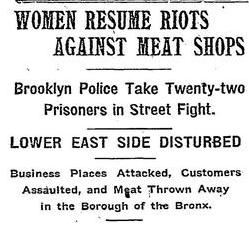
In May 1902, immigrant Jewish housewives in the Lower East Side of New York City launched a boycott, lasting about 3 weeks, against kosher butchery shops in Brooklyn, Harlem, and the Bronx. Triggering this movement was the Beef Trust, a coalition of wholesale butchers that had spiked the prices of kosher meats beyond what was affordable for working-class immigrant families. For these Jewish immigrants, the kosher meats were not a luxury choice but a religious obligation, making the price feel like a direct assault on their community life, making it much more difficult to assimilate smoothly. The boycott was organized by local women from all different boroughs of NYC, most of them being middle-aged mothers working through the difficult social landscape of adapting to life in the U.S. Sarah Edelson and Caroline Schaatzburg were key figures in the protest, as the latter served as president of the Ladies Anti-Beef Trust Association. The wholesale butchers and local leaders tried to hijack the movement and many papers dismissed the whole effort as politically unsophisticated, but the Yiddish press covered the disruption in all seriousness. While the English language socialist papers discredited these women’s efforts, the community, for the most part, backed them. Their deliberate tactics of calling themselves strikers involved ideas of American free speech and leveraged their power over the market. The English press called them animals, but they saw justice.

Carnival Against Capital? (OWS 2011)

2011-Present, Authority, Consciousness Raising, Date, Defining the Enemy, Disruptive Spaces, Strike, Subjectives of Refusal, Subjects Redefined, Tactics of Disruption, The Bourgeoisie, The Workplace, Urban Spaces, Workers

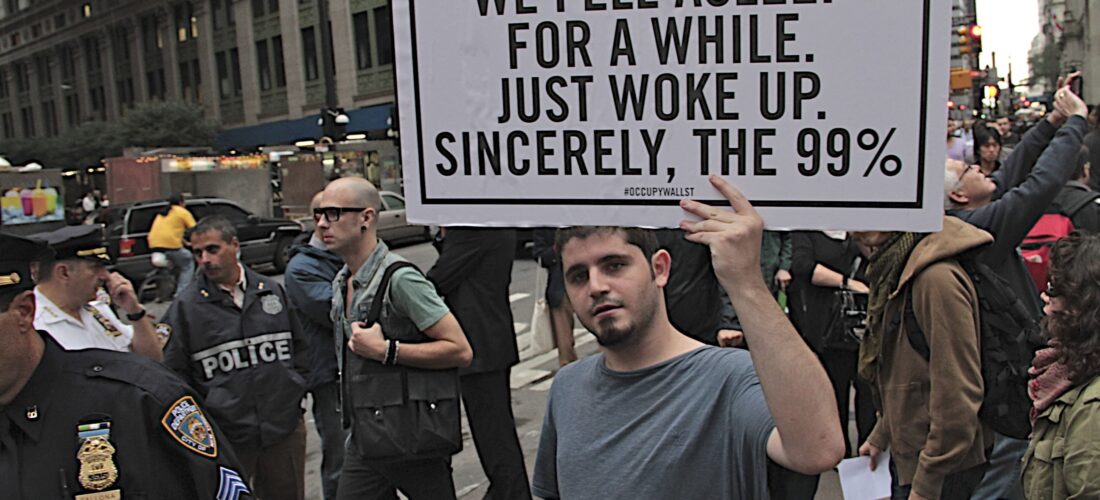
In September of 2011, thousands of protestors occupied Zuccotti Park in Lower Manhattan, protesting Wall Street’s role in the 2008 financial crisis and decades of inequality leading up to it. The media wrote it off as a disorganized street party because of the costumes, drums, and even paper-mâché unicorns, but in reality, it was a deliberate protest with a history substantially longer than realized. Claire Tancons traces the carnival-esque tactics of the movement all the way back to slave societies in the Americas, where the drama and spectacle of this protest were often a tool used to attract attention from people with no formal political power. OWS was evicted two months in, two days before its planned Day of Action. It never made a single concrete demand, which critics used to dismiss it entirely. But the 1% versus 99% framing it popularized genuinely shifted how Americans talked about inequality, and the organizing models it developed influenced basically every major left movement that came after it. Tancons’ piece is worth reading not just as analysis but as a primary source — she was writing in real time, from inside the movement’s own cultural logic, which makes it a different and more honest document than most of what got published about OWS at the time.

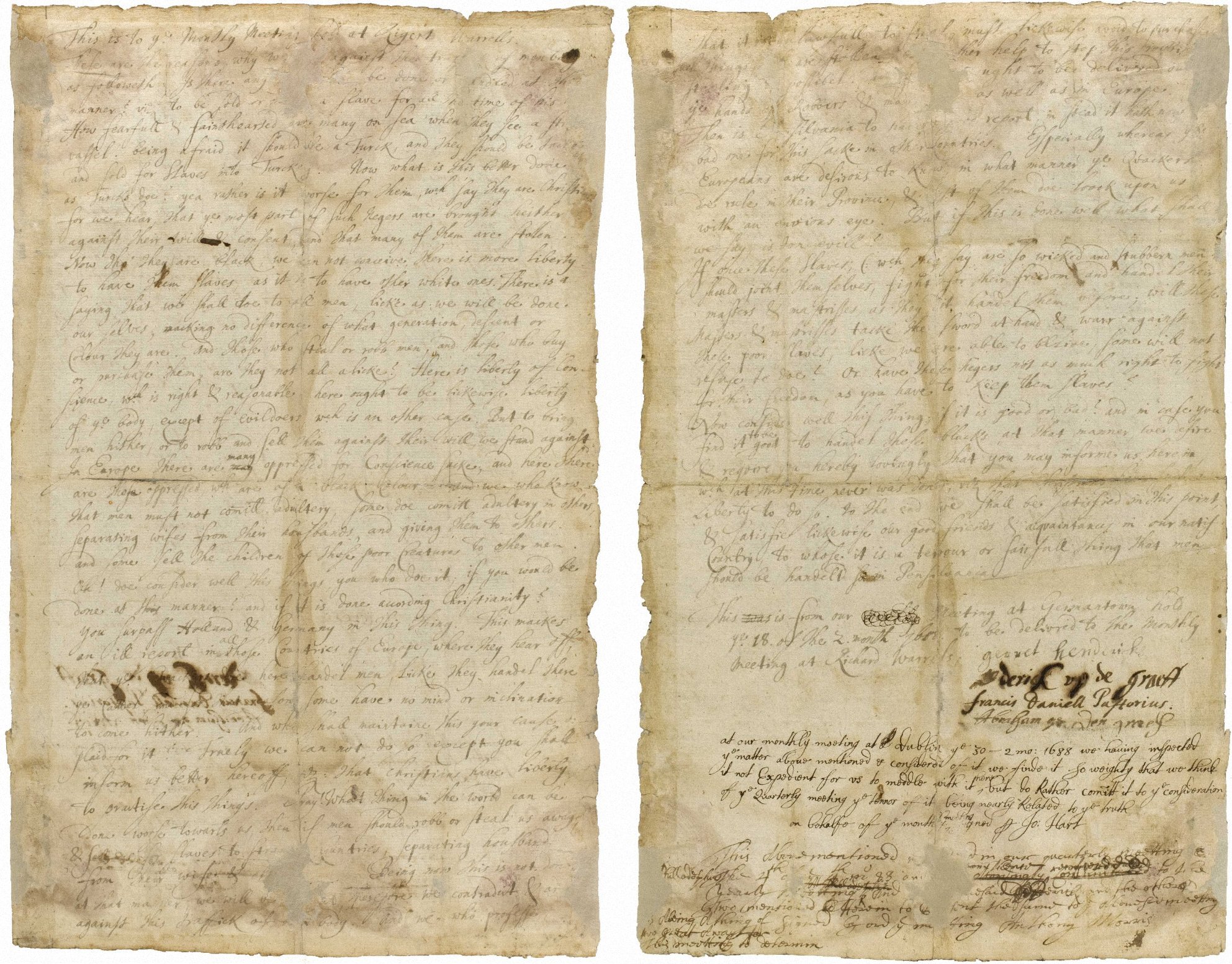
Germantown Quaker Petition Against Slavery (1688)

Authority, Black, Consciousness Raising, Date, Defining the Enemy, Disruptive Spaces, Institutions, Pre-Modern, Subjectives of Refusal, Tactics of Disruption, White Supremacy

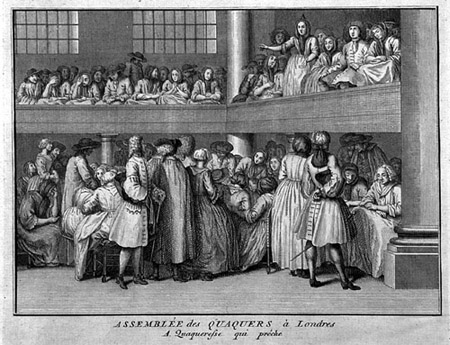
This petition served as the first official written protest of slavery in the new world. While it is not a direct rebellion, or call for physical action, the petition and German Quaker organization critiqued slavery for its moral violations of Christian ethics. More accurately, this petiton can be viewed as a call for collective reflection rather than collective action on the issue of slavery in British North America. Because it was only passed along through Quaker governing bodies, this document failed to bring about much driect or disruptive action. It did however, set quite the precedent for future abolitionist movements. While the immorality argument against slavery seems to be a common theme in abolitionist movements now, this petition was the first time morality was utilized to spark a change in social structure.

Heart Mountain Fair Play Committee Manifesto (1944)

1840-1945, Authority, Consciousness Raising, Date, Defining the Enemy, Disruptive Spaces, Institutions, Tactics of Disruption

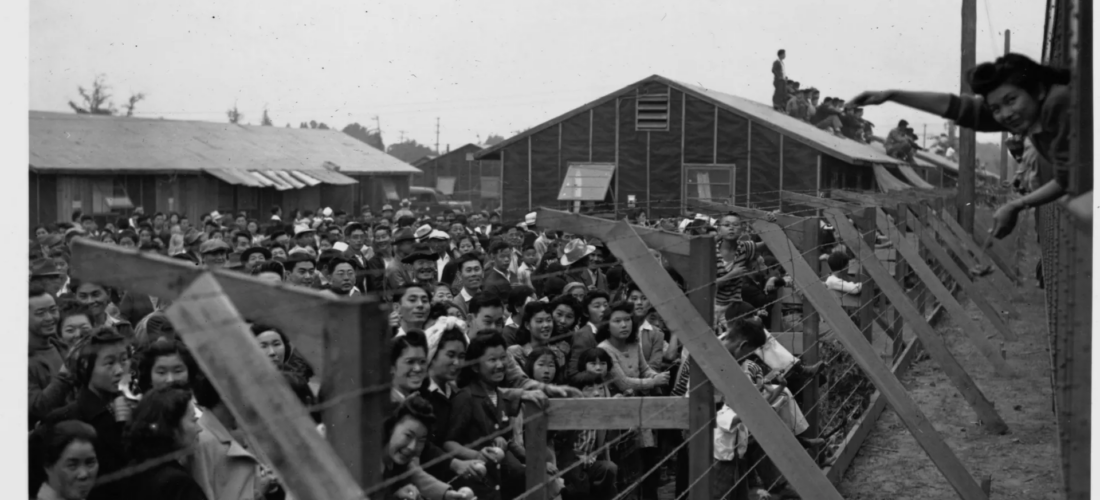
This document, regularly known as the Heart Mountain Fair Play Committee Manifesto, attempts to ignite a united response against the violation(s) of their constitutional rights. This committee and the ensuing manifesto were primarily focused on protesting the forced conscription of imprisoned Japanese-Americans into the United States Army. The argument in this manifesto is quite intriguing in its underlying tone of civic pride. While they are demanding an upheaval of the discrimination placed against them, they are still eager and willing to defend the constitutional rights not being granted to them. This committee did not carry a tone of animosity in its argument(s), but rather called for justice and free will to be restored to all individuals who called themselves American. The Japanese-Americans, through this committee, were not looking for a dramatic or revolutionary upheaval of the system, but rather a return to the promises and institutions that founded the United States.

We would gladly sacrifice our lives to protect and uphold the principles and ideals of our country as set forth in the Constitution and Bill of Rights, for on its inviolability depends the freedom, liberty, justice, and protection of all people including Japanese-Americans and all other minority groups.

A Yarn to Follow: The Dover Cotton Factory (1812—1821)

1700-1830s, Authority, Date, Defining the Enemy, Disruptive Spaces, Imperialism, Patriarchy, Strike, Subjectives of Refusal, Tactics of Disruption, The Workplace, White Supremacy, Women

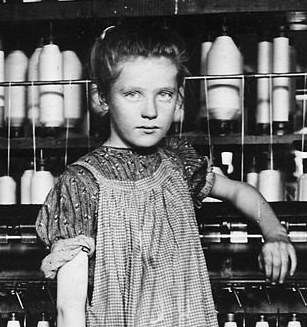
In December 1828, roughly 400 women walked off the looms of the Cocheco Manufacturing Company in Dover, New Hampshire. They marched around the mill quadrangle with banners, signs, and loud, empowering music. The local paper, the Dover Enquirer, responded with contempt, calling the action “one of the most disgusting scenes ever witnessed” and dismissing the workers’ grievances as purely imaginary.
It was the first recorded strike by women in United States history. And it almost didn’t happen at all.

When the Dover Cotton Factory opened in the 1810s under founders John Williams and Isaac Wendell, it operated under a paternalistic but somewhat livable arrangement. Farm girls were recruited from across New Hampshire and southern Maine with promises of good wages, boarding houses, and moral supervision, 10 PM curfews, mandatory church attendance, and an illness fund. Mill work was, briefly, considered a respectable path to financial independence for women who had almost no other routes to it. That shifted dramatically in 1828, when a Boston-installed agent named James Curtis took over. Curtis cut hourly pay from 58 cents a day to 53 cents while simultaneously raising production quotas and increasing loom worker speeds. Workers were paid in company scrip, redeemable only at the factory store, where prices were inflated, and accounts were routinely falsified. Talking on the floor was forbidden. A 12½-cent “lateness” fee was imposed. Joining a union was cause for immediate dismissal. On December 30, 1828, about 400 of the 800 mill girls walked out. The women didn’t slip quietly out the door; they marched, with banners and music, making their dissent visible in a town that had never seen anything like it. The strike failed. The women returned to work three days later, having won nothing. Curtis remained an agent until 1834, when he resigned — not because the workers forced him out, but apparently on his own terms. A second turnout in 1834 also failed.

https://www.dover.nh.gov/government/city-operations/library/research-learn/history/a-yarn-to-follow/: A Yarn to Follow: The Dover Cotton Factory (1812—1821)
Sonthonax Abolition of Slavery (1794)

1700-1830s, Consciousness Raising, Date, Privatization, Self Institution, Tactics of Disruption, The Workplace

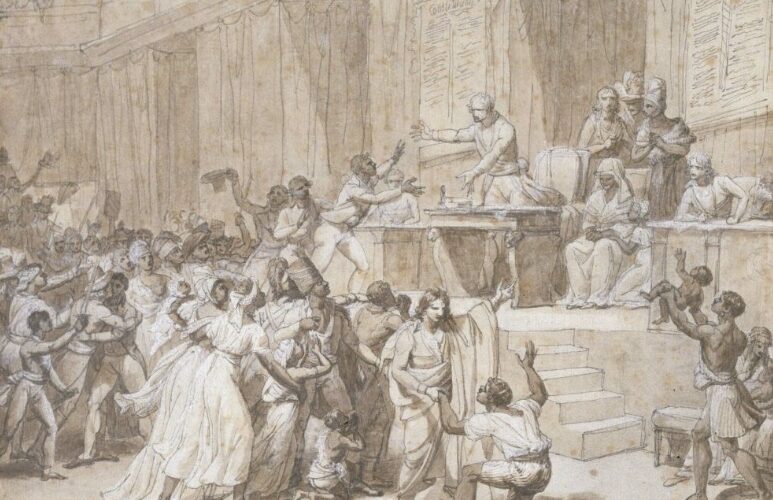
On August 29, 1793, Léger-Félicité Sonthonax, civil commissioner of the northern part of the French colony Saint-Domingue (present-day Haiti), issued a decree that formally abolished slavery forever in his region of the colony. This proclamation, which was seemingly the first of its kind, created a snowball effect that eventually led to the National Convention’s official Feb 4, 1794, decree abolishing slavery throughout all of the French colonies. Used initially as a tactic for securing the colony for French control in the face of British invasion and colony-wide slave revolt, Sonthonax can easily be credited with paving the way for early calls for the abolition of slavery, and was a primary initiator for the French being one of the first countries to formally abolish the institution of slavery throughout all of their provinces and colonies. What began as a “small” political action in the northern region of a colony with a very large slave population established one of the most disruptive chains of events for the abolition of the institution of slavery.

“Ain’t I A Woman” (1851)

1840-1945, Black, Consciousness Raising, Date, Defining the Enemy, Subjectives of Refusal, Tactics of Disruption, White Supremacy, Women

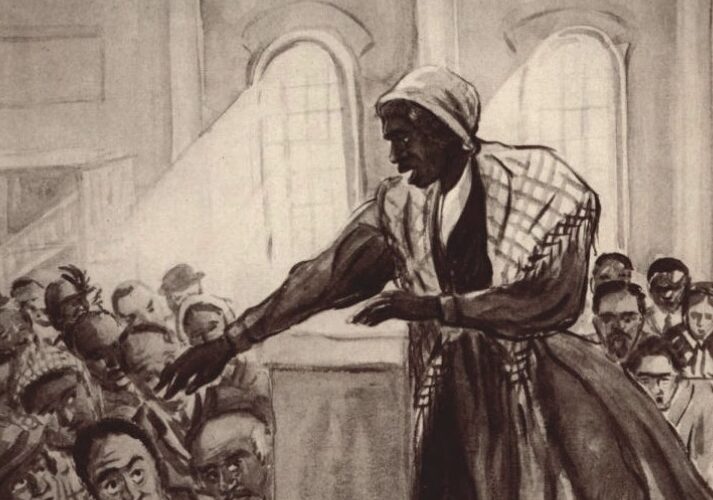
Sojourner Truth was a prominent American abolitionist, speaking out primarily for African-American civil rights, women’s rights, and alcohol temperance. In this speech given at the Akron, Ohio, Women’s Convention in 1851, Truth was a pioneer in demonstrating the dual burden Black women faced. Seeing as this demographic was facing both deep-rooted racism and sexism, she, in this speech, attempts to describe the potential for disruption that these women had. It was also very important to Truth to legitimize the rights of Black women. She describes how, at this dawn of women’s rights activism, White women were given more legitimacy in the eyes of men, but Truth is disrupting preconceived conventions by asking, “And ain’t I a woman?” While in this era of abolitionism, we primarily focus on the civil rights of the enslaved, we regularly forget that in this period, early calls for the equal rights of women were beginning to emerge. Truth, makes sure that we don’t forget the demographic that was affected by both of these movements, Black women.

The Liberator’s Salutation (1831)

1700-1830s, Black, Consciousness Raising, Date, Strike, Subjectives of Refusal, Tactics of Disruption

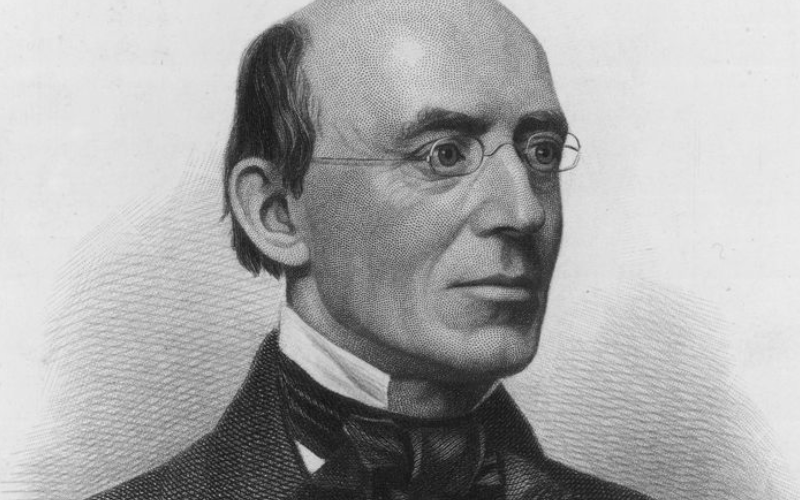
The Liberator served as one of the most disruptive calls for abolition that existed in the Civil War era. In circulation from January 1831 to December 1865, this newspaper was primarily published by William Lloyd Garrison, and in this “Salutation” that was issued in the first print, we can see the primary purpose for the paper, and the radical, disruptive measures it was looking to make in order to abolish slavery. Using incredibly provocative language, Garrison, with this “Salutation,” was successful in his continuous call(s) to action. Newspapers, such as the Liberator, were extremely effective forms of disruption in the way(s) that they were able to spread awareness and validation for the ever increasing abolishtionist movement.

My name is “LIBERATOR!” I propose
To hurl my shafts at freedom’s deadliest foes!
My task is hard—for I am charged to save
Man from his brother!—to redeem the slave! 

Our Countrymen in Chains (1841)

1840-1945, Black, Colonized, Consciousness Raising, Date, Subjectives of Refusal, Tactics of Disruption

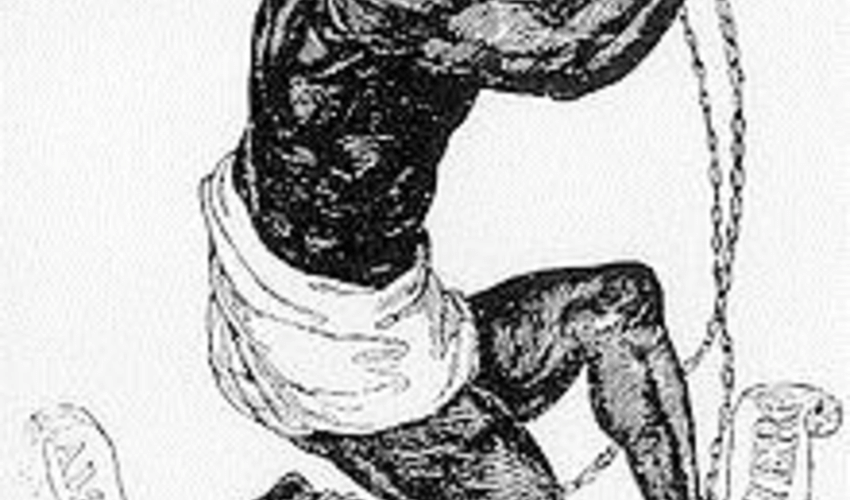
With the use of publications such as the Mirror of Liberty, authors such as John G. Whittier were able to advance their radical abolitionist agenda. In this poem, titled Our Countrymen in Chains, Whittier used abrasive language and vivid verbal imagery to attempt to describe the plight of the enslaved man. Often coupled with this work is the “Am I Not a Man and a Brother?” image (as it is here) and is truly an example of disruptive moral propaganda. While many works such as this were designed to incite direct violent action against the supporters of the slave industry, Whittier decides to make the ever-difficult appeal of emotion to stir disruptive tendencies. His call to “scatter the living coals of truth” throughout the heart of the nation offers the clearest insight into his disruptive agenda.

And shall we scoff at Europe’s kings, when Freedom’s fire is dim with us, and round our country’s altar clings the damning shade of Slavery’s curse?

David Walker’s “Appeal to the Colored Citizens of the World” (1829)

1700-1830s, Black, Defining the Enemy, Subjectives of Refusal, Uncategorized, White Supremacy

David Walker was born a free man in North Carolina on September 28, 1976. He later moved to Boston, where he began writing for the nation’s first African American newspaper. In 1829, while working with this newspaper, he published this Appeal to the Colored Citizens of the World. This appeal was a collection of essays that focused on appealing to the nation’s civic duty, what he believed was an inherent sense of Christianity, and finally, a sense of early black nationalism. While this pamphlet has a unique take on disruption for its use of Christian morals as a call to action, it was effective in its coupling with calls for radical abolitionism and critiques of the founding tenets and members of our nation, such as Thomas Jefferson and the Declaration of Independence.

The whites have always been an unjust, jealous, unmerciful, avaricious and blood-thirsty set of beings, always seeking after power and authority.

Are Women the Problem or Solution to Global Change and Insecurity?

Defining the Enemy, Disruptive Spaces, Institutions, Patriarchy, Subjectives of Refusal, The Workplace, Urban Spaces, Women

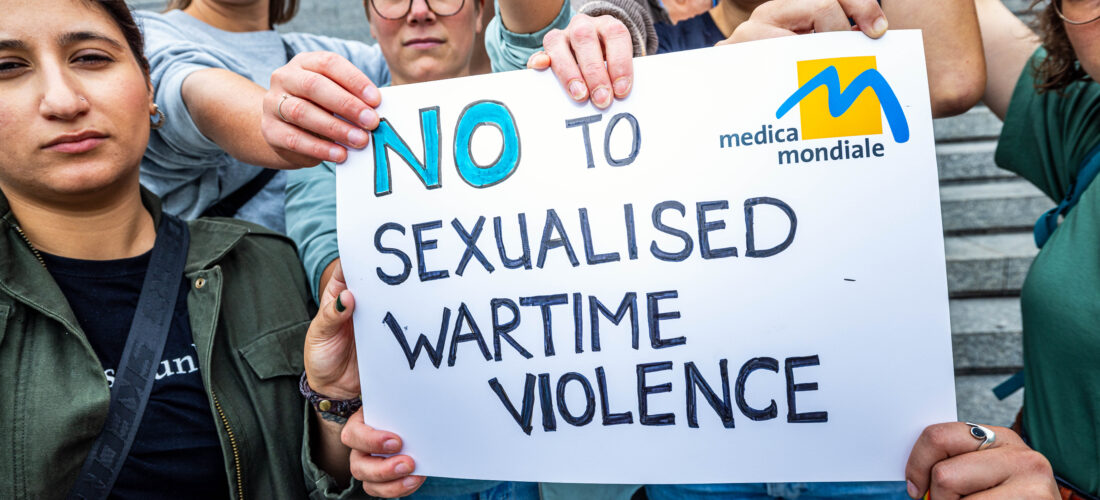
In this chapter, some of the major issues relating to gender and social policy in an international perspective are outlined, and an analytical framework is suggested that might help to forge policies. Ruth Pearson addresses the implications of war or conflict on women, focusing on women’s role as the “reproducer”. Pearson addresses the dual meaning of this terminology: both the biological process and the process of domestic labor. She describes how women’s sexuality is often constrained during times of global insecurity, as the conditions that they enjoy or allow sexual activity are limited because of patriarchal gender relations. Additionally womens bodies become a means of control during times of conflict and often are taken advantage of through assault or rape as ameans to further strategic or political ends. This is representative of patriarchal means of control and military action used in Uganda in the 1980’s, in East Bengal in 1968, and countless other times. Rape and other sexual humiliation and torture have become commonplace in many countries around the world presenting the debate about the morality of bearing children as a product of rape. Often religion plays a crucial role in these decisions and women are pressured to carry the child to term and care for it in a safe loving and nurturing manner but social policies and more recent campaigns have been enacted to protest women’s bodily autonomy and support individual decisions regarding reproductive health and care. This chapter as a whole addresses the need for social and economic policy to not use women as the source or instrument to pursue certain priorities or agendas and promote the analysis of gender relations, intersectionality and legitimate policy objectives. 

The Wages for Housework Movement: A Radical Disruption of Economics, Labor, and Feminism

1946-1989, Consciousness Raising, Date, Defining the Enemy, Disruptive Spaces, History, History/Theory, Patriarchy, Subjectives of Refusal, Tactics of Disruption, The Home, The Workplace, Theory, Women, Workers

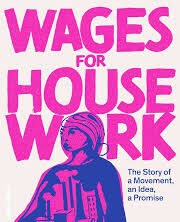
In the 1970’s, the Italian campaign, Wages for Housework, emerged as an incredibly disruptive intervention to feminist politics as well as economic theory. Martina Gabrielli analyzes how the movement went above and beyond demanding financial compensation for domestic labor, as the movement challenged capitalism’s definitions of value, work, and productivity. The movement questioned mainstream understandings of “work” and sought answers as to why domestic labor and housework were unpaid, exemplifying society’s inability to see value in predominantly female roles of reproductive work. Before the rise of the movement, domestic labor was treated as a private responsibility, undeserving of being recognized as economic activity, as it was often viewed as a labor of love and expression of femininity outside the realm of wages and markets. Within numerous feminist movements, the common solution to female oppression was smooth integration into paid work and equal access to employment opportunities, but neglected social reproduction: the unpaid work of cleaning, childcare, cooking, and emotional support that enabled (often husbands, or male) wage labor. The movement argued that capitalism succeeds due to its equal dependence on unpaid reproductive labor and factory production. The debate sparked conversation about exploitation, which had previously never been thought of occurring inside the home, as it was traditionally seen as apolitical. The peak activity and influence were during 1972 and 73 were Dallas Costa released E Sovversione Sociale, a document that delves into the disproportionate burden of domestic labor on women, and argued that even women with jobs outside the home shoulder the bulk of household responsibilities. The main framework within the women’s capitalist division of labor reinforces the notion that women’s extended familial duties encompassing emotional and caregiving responsibilities are deemed not worthy of being paid, akin to wage labor. This position diverges from the dominant promotion of female integration into the workforce, as it focuses on predating the introduction of wages for reproductive jobs. The Lotta Feminista’s activism rejects the capitalist system, which has centered the monetization of predominantly male productive labor and prompted the centering of women’s reproductive labor in the paid workforce.

Resistance After Galeano’s Murder in the Zapatista Movement

2011-Present, Authority, Defining the Enemy, Disruptive Spaces, History, History/Theory, Privatization, Subjectives of Refusal, Subjects Redefined, The Workplace, Uncategorized, Urban Spaces, Workers

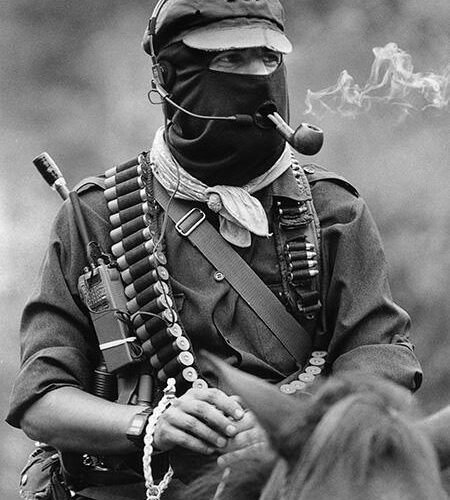
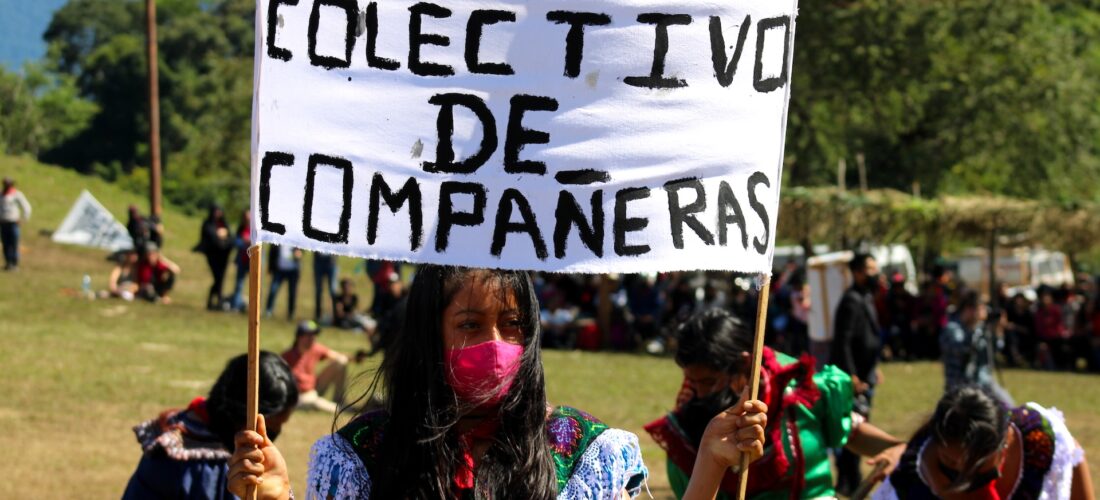
Raheel Hayats essay looks at an important time for the Zapatista movement. This was after the murder of José Luis Solís López, also known as Galeano in 2014. He was a teacher, with the Zapatistas. State-backed paramilitary forces killed him in Chiapas. They did this as part of a campaign to stop the Zapatistas and other indigenous people from being independent, with the goal to make it easier for companies to take the resources from the area without any problems. The Zapatista movement is still fighting against this. The attack on the school and health clinic showed how the Mexican government uses violence and controls what people see in the media to hurt communities that are trying to be independent. They also get some peasant groups to work with them. The Zapatistas did not fight back with violence, instead they wanted justice to be done in their way. They did not want to use violence like the government. The essay describes how when Subcomandante Marcos appeared to die after Galeano was murdered it was not a sign that the movement was weak, it was proof that the movement was strong. Subcomandante Marcos was a person who helped tell people outside of the movement what was going on. He was also getting in the way of people seeing the real heart of the movement, which is made up of a lot of different indigenous people working together. The movement is really about these people, not just, about Subcomandante Marcos. By stepping aside and elevating indigenous leadership, the Zapatistas demonstrated that their power lies not in charismatic figures but in deeply rooted, bottom-up institutions of governance, education, and care, showing that they are stronger than ever as a collective challenge to capitalism, state violence, and neoliberal exploitation. This moment was deeply disruptive because it overturned the state’s expectation that repression, assassination, and the removal of a visible leader would fracture the movement, instead revealing a form of resistance that thrives precisely by refusing hierarchy, spectacle, and violent retaliation.

Capitalism Shakes the World

2011-Present, Authority, Date, Defining the Enemy, Disruptive Spaces, History, History/Theory, Infrastructure/Data, Institutions, Privatization, Subjectives of Refusal, The 'Natural World', The Home, The Workplace, Theory, Urban Spaces, Workers

In the last five hundred years, virtually all traditional patterns of life and livelihood have been disrupted and reconstructed. The world and world’s peoples have been shaken up and remade.

Samuel Bowles

Capitalism’s prioritization of profit and accumulation through competition over stability and social well-being undermines security, harms the natural environment, divides familial networks, and destabilizes income. Long working hours and the ever-changing job market strain relationships within families, making parents increasingly more reliant on outsourcing childcare. Constant technological advances reshape the job market, shifting economic risk from corporations onto individuals. Reliance on fossil fuels for production takes a significant toll on the environment. All these drawbacks of the never-ending technological revolution exemplify the inability to sustain a capitalist system and the dissatisfaction of all individuals within this society. Capitalism is disruptive not only during economic failures but also because its normal functioning succeeds, though destabilizing families, ecosystems, and lives while wealth is concentrated in the hands of a few.

The Jungle by Upton Sinclair (1906)- A Disruptive Literary Work

1840-1945, Consciousness Raising, Date, Defining the Enemy, Disruptive Spaces, Privatization, Tactics of Disruption, The Bourgeoisie, The Home, The Workplace, Urban Spaces

“We shall have the sham reformers self-stultified and self-convicted; we shall have the radical Democracy left without a lie with which to cover its nakedness!”

Upton Sinclair

The contents of Upton Sinclair’s “The Jungle” expose the gruesome truth of the meat-packing industry, but more importantly, exemplify the explosion of the boundaries of American Literature. During the early 1900s and late 1890s, popular and frequent novels focused on romanticized progress and prosperity in America, praising capitalism, promoting ideas of hard work, and instilling hope for achieving the American Dream within the country’s youth. Sinclair on the other hand, forced readers to witness filth, exploitation, abuse, and the human cost associated with the “advancement” of industrial capitalism. Rather than the typical narratives about individuals or families moving up the socioeconomic ranks of the capitalist structure, Sinclair exposes the structural violence, slavery, housing fraud, workplace abuse, starvation, harm, and death behind this illusion of capitalism as the perfect path to success. Once published, Sinclair’s piece triggered the public, and his novel was investigated by the federal government. The contents of this book are incredibly graphic, disturbing, and harmful, and Sinclair’s publication ruptured everyday political life and caused disturbances to common perceptions of capitalism and America’s economic system. This piece opened readers’ eyes to the hidden costs of production, increased manufacturing, and capitalism, challenging the government’s one-sided presentation of capitalism’s benefits, revealing the truth they aimed to conceal.

bell hook’s “Feminist Movement to End Violence” (1984)

1946-1989, Black, Date, Defining the Enemy, Patriarchy, Subjectives of Refusal, White Supremacy, Women

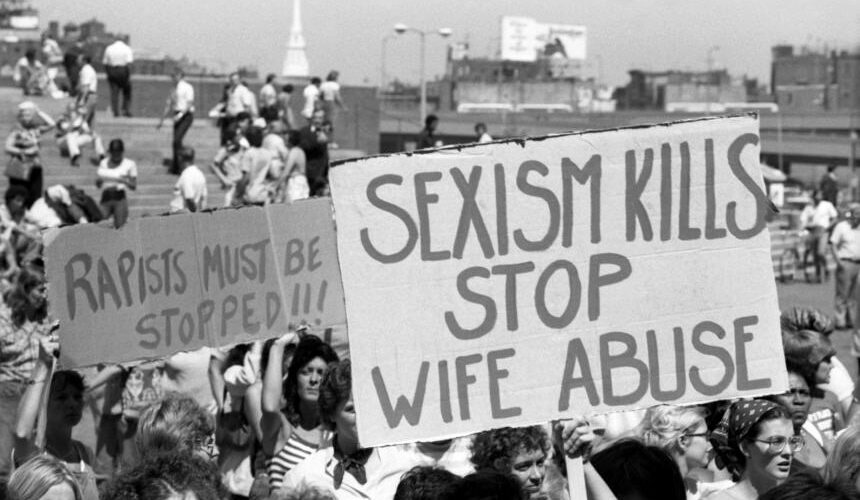
This chapter in bell hooks’ book “Feminist Theory: From Margin to Center” challenges deeply normalized beliefs about power, authority, and violence in everyday life. Instead of merely condemning individual acts of male violence against women, she describes a movement that disrupts social norms by exposing how violence is embedded in hierarchical systems such as patriarchy, capitalism, white supremacy, and the family itself. This perspective unsettles societal norms because it forces both men and women to confront their own participation in and acceptance of coercive power, including the ways violence is justified as discipline, love, protection, or authority. By questioning long-standing assumptions that domination is natural and necessary, this movement threatens institutions that rely on control and obedience. hooks argues that this disruption is necessary, because ending violence requires transforming cultural values and social relationships at their core, not merely managing or punishing violent behavior after it occurs.

Sidi M. Omar on the Preservation of Colonialism

2011-Present, Authority, Black, Colonized, Defining the Enemy, Disruptive Spaces, History/Theory, Imperialism, Indigenous, Latino, Subjectives of Refusal, The Workplace, Uncategorized, Urban Spaces, White Supremacy

Postcolonial theory challenges the proposition of colonialism as a closed chapter of history. It insists that political systems, economic dependencies, and even a structure of knowledge production persist in continuing colonial power structures. Sidi M. Omar’s work exposes how colonial domination carries on currently, a lot more than most people may think or know. Omar’s scholarship deals with Western Sahara, one of the world’s longest-standing unresolved colonial situations. While often framed as a territorial “dispute,” Omar disrupts this framing by naming what that is: an ongoing process of colonial occupation. From a postcolonial perspective, this re-naming is important. It reveals how colonial powers keep control, not just through force, but through language, law, and selective recognition on the world stage. Often, categories of Developed vs Undeveloped, First vs Third World, and Global North vs South are used to describe economic status groupings of nations based on GDP, another example of frequent renaming with the intent to be politically correct, but always falling short. The constant renaming of developmental statuses becomes redundant and meaningless as there are no terms that can fully encapsulate the lived reality of an entire place–much less a whole country. This goes for the use of GDP as well, as it can never be an all-encompassing measure of development, as it fails to account for many other factors that contribute to growth, development, productivity, the economy, and more.

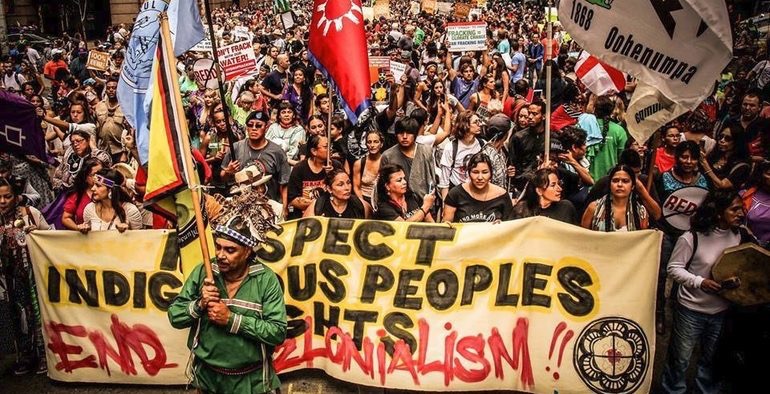
A central contribution of Omar’s work is his critique of those international institutions that claim neutrality while reinforcing colonial hierarchies. Omar describes how legal frameworks that were to protect self-determination themselves become tools that delay it. Omar further disrupts dominant modes of knowledge, reminding us to be aware of whose voices get louder-and whose are muted-is never an accident. By placing the Sahrawi voices at the center, Omar resists an Eurocentric narrative of colonized peoples rendered passive or helpless. Instead, he foregrounds resistance, political agency, and historical continuity. In this way, it is not simply a postcolonial work of Sidi M. Omar; it’s actively disruptive. His perspective insists that thinkers revisit their own ideas on questions of sovereignty, legality, and justice in a world where colonialism has not ended, merely evolved. He challenges the common notion that “colonization is in the past’ while providing current examples of imperialist policies and ideologies that prevent development by promoting interdependence and maintaining power hierarchies that benefit wealthy nations and belittle the poor.

The Global Consequences of American Consumption & Fast Fashion

2011-Present, Authority, Colonized, Date, Defining the Enemy, Disruptive Spaces, Imperialism, Subjectives of Refusal, The 'Natural World', The Workplace, Uncategorized, Urban Spaces, Workers

“Around the world, the equivalent of one dump truck filled with clothing is sent to a landfill or incinerator every second.”

Eric Liedtke

Clothing companies produce twice as much clothing today than they did in 2000, and the average American consumer now purchases four times as many clothing items as they did in that same time period. It’s estimated that Americans don’t wear about 50% of the clothing they own, and 65% of the clothing they purchase ends up getting disposed of within 12 months. Because of this, clothing is often exported to Global South Countries, disguised as assistance, sending clothing to countries in need when in reality it causes substantially more harm. The United States sends over 15 million articles of clothing to Ghana a week, ending up in massive secondhand markets like Kantamanto Market in Accra, creating a significant waste crisis as up to half the imported garments are unsellable, clogging landfills, polluting beaches, and overwhelming local waste systems with textile waste, much of it fast fashion that quickly becomes trash. This extreme quantity of unwanted clothing is a disruptive force that restructures everyday life in places like Accra, while the cause (fast fashion companies and exporting companies like the U.S.) creates an environmental catastrophe by forcing this immense burden upon lower-income nations on the other side of the world. Local textile producers and tailors are pushed out of business as secondhand fast fashion floods the market at prices they cannot compete with, eroding domestic industries, productivity, and livelihoods. At the same time, the sheer volume of unsellable garments turns consumption in the Global North into environmental destruction in the Global South, shifting the burden of waste management onto communities with the least infrastructure to absorb it. What appears as excess convenience for American consumers thus becomes economic displacement, ecological degradation, and public health risk elsewhere—revealing overconsumption as a global system of harm rather than an individual choice. The documentary “Buy Now!”, as well as various other environmental sources, exposes the harm of overconsumption, and its parallels to imperialist and colonizing methods specifically in America.

https://www.documentaryarea.com/video/Buy+Now!+The+Shopping+Conspiracy

Jane M. Jacobs’ “Earth and Honoring: Western Desires Indigenous Knowledges” (1994)

1990-2010, Date, Defining the Enemy, Imperialism, White Supremacy

Western engagement with Indigenous knowledge often disrupts the existing structures within Indigenous communities. By framing Indigenous knowledge as objects of desire for environmental or feminist agendas, Western actors inadvertently impose external norms on communities with their own political and cultural priorities. This can disrupt traditional authority structures, gender roles, and decision-making practices, as Indigenous knowledge is selectively highlighted to fit Western narratives. This text shows that even well-intentioned alliances may reproduce colonial power dynamics, privileging Western perspectives while undermining Indigenous agency. The objectification of Indigenous knowledge by the West has created tension between maintaining cultural sovereignty and engaging with broader political movements.

Hazel V. Carby’s “On the Threshold of Woman’s Era” (1985)

1946-1989, Black, Date, Defining the Enemy, Patriarchy, Subjectives of Refusal, White Supremacy, Women

Carby writes about how Black feminist thought emerged in direct opposition to the racial, sexual, and imperial systems that structured American society. She discusses how lynching functioned not only as racial terror against Black men but also as a means of regulating Black women’s sexuality and silencing their political agency, reinforcing white supremacy and patriarchal power. Black women’s activism disrupted this order by challenging dominant narratives that portrayed white women as the sole victims of sexual violence while erasing the experiences of Black women. By organizing against lynching, imperialism, and racist representations of sexuality, Black women exposed the limits of mainstream feminism and destabilized its universal claims about womanhood. This resistance forced a redefinition of feminist politics, showing how struggles against racism reshaped existing ideas of gender, power, and social order.

Real Democracy Now!

2011-Present, Authority, Date, Defining the Enemy, Disruptive Spaces, Occupation, Students, Subjectives of Refusal, Tactics of Disruption, The Workplace, Urban Spaces, Workers

“The constant and necessary distinction between the rules and the ruled, however, prevents us from calling representative democracy a ‘real democracy’. A real democracy, according to Hardt and Negri can only exist when there is no distinction between rulers and ruled.”

Thomas Decreus

This document is a 2011 political theory essay by Thomas Decreus analyzing the Occupy and Indignados movements as experiments in direct, horizontal democracy and critiquing their rejection of traditional political representation. These movements were incredibly disruptive as they challenged the foundations of democracy and the functions of political representation and preservation of economic inequality. Occupy rejected representative politics- they didn’t lobby leaders or propose reform, they argued for the creation of the unbridgeable divide between rulers and the ruled. They occupied public spaces, assemblies, and disrupted urban life while simultaneously experimenting with alternative forms of democracy based more directly on public participation and collective decision making and deliberation. Occupy exposed the limits of a representative democracy and demonstrated that these protests themselves could function as a form of democratic practice rather than merely a demand for reform.

David Graeber on Occupy Movement

2011-Present, Authority, Date, Defining the Enemy, Occupation, Privatization, Subjectives of Refusal, Tactics of Disruption, Workers

David Graeber was an American anthropologist, author, and activist who often critiqued capitalism, promoting his anarchist politics. He was actively involved in the Occupy Wall Street Movement, and popularized the “We are the 99%” slogan, as well as wrote many influential books that challenged conventional economic ideas. In this interview, he describes how his family lacked books of critique, prompting his anthropological interests and becoming fascinated with anarchy and public movements. Graeber, in this 2014 interview, describes how Occupy is not gone, and projects continue around the United States and the world. He viewed the movements as genuine democracy– an anarchist movement that exposed the corruption within social, political, and economic spheres of U.S. life. He describes the necessity to challenge financial power and argues that the success was not immediate change but the creation of space allowing for creative expression, imagination, and rebuilding. These movements challenged the legitimacy of a corrupt system, which Graeber describes as continuously challenged, even years after the more “formal” or notable Occupy movements.

Natalie Zemon Davis’ “Iroquois Women, European Women” (1973)

Uncategorized

Davis shows that Indigenous women resisted traditional European gender roles by maintaining forms of authority and autonomy that sharply contrasted with French patriarchal norms. European observers expected women to be submissive, economically dependent, and excluded from decision-making, yet Iroquois women controlled agriculture, household resources, and kinship through matrilineal and matrilocal systems. Senior women exercised influence within the longhouse, could initiate divorce, retained custody of children, and had decisive power over daily economic life—practices that undermined European assumptions about male dominance within the family. Even when exposed to Christianity, some Indigenous women adapted the new religion to expand their public voice, preaching, teaching, and leading prayer despite missionaries’ insistence on female obedience. Rather than passively accepting European gender ideals, Iroquois women reshaped colonial encounters to preserve their authority.

“If a man wanted a courteous excuse not to do something he could say without fear of embarrassment ‘that his wife did not wish it.’”

Chandra Talpade Mohanty’s “Under Western Eyes” (1984)

1946-1989, Date, Defining the Enemy, Imperialism

Mohanty explains in her essay how Western feminist scholarship applies universal categories of gender and oppression to women in the Global South. She argues that this disrupts the true meaning of feminism because the diverse histories and lived experiences of non-Western women are flattened into the singular figure of the “Third World woman,” erasing cultural, class, and political differences. Such discursive homogenization distorts feminist political practice by reinforcing hierarchical power relations between Western and non-Western women and undermining the possibility of meaningful transnational solidarity. By positioning Western women as the norm, colonial legacies within feminist discourse itself are reproduced, disrupting efforts to build coalitions grounded in shared but context-specific struggles. Mohanty frames this disruption not as a breakdown of feminism, but as a critical failure that demands more historically situated, self-reflexive feminist analysis.

“It is in the production of this ‘third-world difference’ that western feminisms appropriate and colonize the constitutive complexities which characterize the lives of women in these countries.”

Angela Davis’ “Racism, Birth Control and Reproductive Rights” (1981)

1946-1989, Black, Date, Defining the Enemy, Patriarchy, Subjectives of Refusal, White Supremacy, Women

Angela Davis explains in her essay how the history of reproductive control over Black women reveals the limitations of liberal and feminist frameworks. Davis presents birth control as a subject entangled with racism, eugenics, and population control, particularly in relation to poor and Black communities. She shows how institutions that claimed to advance women’s freedom, such as public health systems, welfare policies, and mainstream feminist movements, simultaneously relied on the regulation of Black women’s reproduction while denying them reproductive autonomy. Black women emerge as a disruptive figure within these systems, as their lived experiences challenge the assumption that reproductive rights are universally emancipatory. By centering practices of coerced sterilization and racially targeted population control, Davis disrupts dominant narratives of progress and individual choice, exposing the contradictions and exclusions that structure prevailing social and political conceptions of reproductive freedom.

Audre Lorde’s “The Master’s Tools Will Never Dismantle the Master’s House” (1979)

1946-1989, Black, Date, Defining the Enemy, Patriarchy, Queer, Subjectives of Refusal, White Supremacy, Women

Audre Lorde challenges dominant White feminist frameworks by insisting that race, class, and sexuality are essential intersectional perspectives for disrupting enduring patriarchal structures. The American feminist agenda has historically dismissed the voices of marginalized women, and these exclusions erase any possibility of genuine collective struggle. Lorde critiques the contradiction of analyzing a racist patriarchy through the very tools produced by that same racist patriarchy, highlighting how such approaches only reinforce existing power relations. To counter this, she calls for the active participation and leadership of lesbian women and Third World women, whose experiences and perspectives offer the foundations necessary for building a form of feminism that is truly transformative.

“I urge each one of us here to reach down into that deep place of knowledge inside herself and touch that terror and loathing of any difference that lives there. See whose face it wears. Then the personal as the political can begin to illuminate all our choices.”

The Zapatista Women’s Revolutionary Law (1994)

1990-2010, Date, Defining the Enemy, Indigenous, Patriarchy, Subjectives of Refusal, Women

The Zapatista Women’s Revolutionary Law establishes women’s rights within the context of the Zapatista armed indigenous uprising. It guarantees women the right to participate in the revolutionary struggle, access work with equal pay, exercise reproductive autonomy, participate in community decision-making, and receive equal social rights. The law frames women’s liberation as inseparable from broader social and indigenous resistance, linking gender equality directly to the fight against oppression.

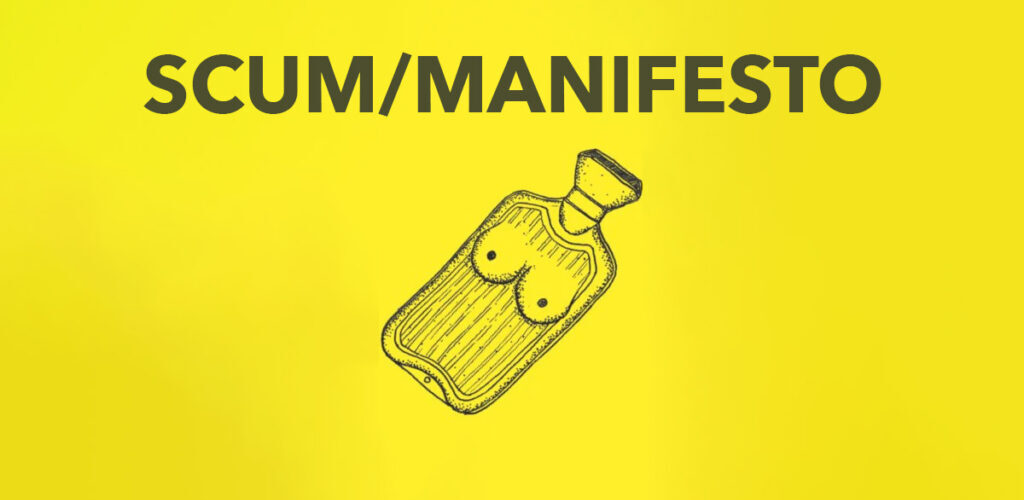
Valerie Solanas’s S.C.U.M. Manifesto (1967)

1946-1989, Date, Defining the Enemy, Patriarchy, Subjectives of Refusal, Women

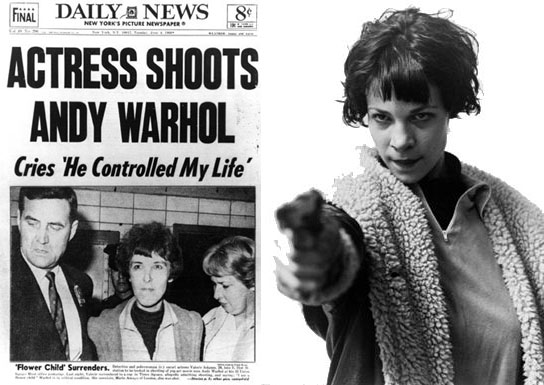
The S.C.U.M. Manifesto is an account of Valerie Solanas’s radical feminist views. She argues that men are incomplete women who spend their lives attempting to become female. Through this pursuit, men have corrupted the world by forming harmful systems that give them a false sense of purpose. To relieve society of this corruption, women must recognize the damage caused by men and tear apart the systems that are ruining the nation. Ultimately, Solanas advocates the eradication of men.

“To be male is to be deficient, emotionally limited; maleness is a deficiency disease and males are emotional cripples.”

SCUM Manifesto (1967)

1946-1989, Date, Defining the Enemy, Disruptive Spaces, Patriarchy, Self Institution, Subjectives of Refusal, Tactics of Disruption, The Workplace, Women, Workers

“So he… proceeds to define everyone in terms of his or her function or use, assigning himself, of course the most important functions-doctor, president, scientist- therefore providing himself with an identity, if not individuality, and tries to convince himself and women that the female function is to bear and raise children and to relax, comfort and boost the ego of the male”

Valerie Solanas

Valerie Solanas publishes the SCUM (Society for Cutting Up Men) Manifesto in 1967, with the intent to describe the flaws of men and the society they’ve established. Men are described as egocentric, sexually driven animals who are incapable of mental interaction and are far inferior to women in all aspects. The manifesto uses sexual and vulgar language to describe men’s (lack of) purpose and how unfit and incompetent they are in filling all duties and roles in society. It is described that men created a society that functions through a work-money system, made to give men a sense of individuality, (doctor, president or scientist), to give them some sort of false value or identity to boost their ego. As the thesis of the SCUM Manifesto is to rebuild society without men, Solanas describes men as only being useful to reproduce, but with the existence of sperm banks, the existence of men is no longer necessary.

SCUM MANIFESTO (1967)

1946-1989, Defining the Enemy, Disruptive Spaces, Patriarchy, Self Institution, Subjectives of Refusal, Tactics of Disruption, The Workplace, Uncategorized, Women

“SCUM is against the entire system, the very idea of law and government. SCUM is out to destroy the system, not attain certain rights within it.”

Valerie Solanas

Valerie Solanas, an American radical feminist, published The SCUM Manifesto in 1967, advocating for the dismantling of patriarchal structures established by men and the creation of a female-led society. Solanas critiques male dominance and systemic gender inequality, arguing that these societal flaws stem from male control. The manifesto calls upon “thrill-seeking females to overthrow the government, eliminate the money system, institute complete automation, and destroy the male sex,” framing men as the root of societal instability and inefficiency, justifying the radical restructuring of society in favor of women, by women.

BUT WE HAVE TO, SO WE DO IT REAL SLOW – Noche (2016)

2011-Present, Authority, Date, Defining the Enemy, Disruptive Spaces, Privatization, Sabotage/Ecotage, Subjectives of Refusal, Tactics of Disruption, The Bourgeoisie, The Workplace, Workers

This collection of texts primarily features an essay titled “BUT WE HAVE TO, SO WE DO IT REAL SLOW” by Noche, which explores the concept of anti-work within the context of Mexican and Mexican-American identity in the United States. The author challenges the prevailing pro-work sentiment, even within radical circles, arguing that elements of labor refusal and resistance are already present in Mexican-American culture, often in subtle or playful forms. The essay contrasts the traditional labor movement’s focus on better working conditions with a call for the abolition of work itself, linking this idea to historical anti-work movements and the critique of capitalism. Noche suggests that everyday acts of slacking, stealing, and working slowly can be seen as forms of resistance, and ultimately advocates for a world free from the constraints of wage labor, the state, and capitalist structures. 

Mothering Against Motherhood: doula work, xenohospitality and the idea of the comrade – Sophie Lewis (2022)

2011-Present, Authority, Date, Defining the Enemy, Disruptive Spaces, Imperialism, Patriarchy, Self Institution, Subjectives of Refusal, Subjects Redefined, Tactics of Disruption, The Home, White Supremacy, Women

This essay, titled “Mothering Against Motherhood: doula work, xenohospitality and the idea of the momrade” by Sophie Lewis, explores the concept of “mothering against motherhood” and “family abolition.” She argues for a communist horizon where care work is collectivized and relationships are based on chosen solidarity rather than biological ties, challenging the capitalist and patriarchal norms embedded in the traditional family.

Be Gay Do Crime – Mary Nardini Gang (2019)

2011-Present, Authority, Blockade/Barricade, Consciousness Raising, Date, Defining the Enemy, Disruptive Spaces, Infrastructure/Data, Institutions, Occupation, Queer, Sabotage/Ecotage, Subjectives of Refusal, Tactics of Disruption, The 'Natural World', The Bourgeoisie, The Home, The Workplace, Urban Spaces, White Supremacy

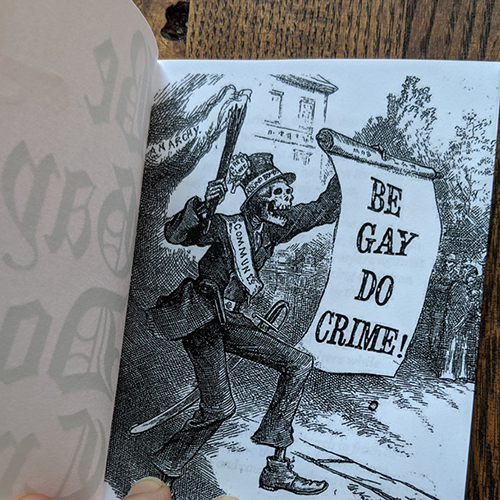
This excerpt, from the introduction of a book titled “Be Gay Do Crime” by Mary Nardini Gang, reflects on ten years of queer, anarchist, criminal, and mystical resistance. It details the origins of their movement in Milwaukee’s Riverwest neighborhood, inspired by insurrections elsewhere and a commitment to a “criminal queer association.” The text emphasizes living a life outside societal norms, viewing normalcy as an enemy, and engaging in direct actions ranging from looting and blockades to caring for comrades and practicing various forms of magic and healing.

The Billboard Liberation Front Manifesto (1992)

1990-2010, Date, Disruptive Spaces, Infrastructure/Data, Sabotage/Ecotage, Tactics of Disruption

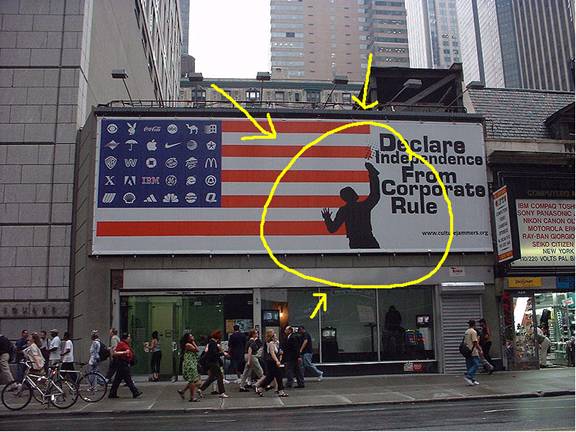
This manifesto argues that in contemporary society, advertising has become the dominant force shaping our understanding of the world and ourselves, displacing older forms of culture like art, science, and spirituality. It posits that media primarily serves to deliver advertisements, and even artistic expression is now largely treated as a commodity influenced by market trends. Ultimately, the document declares that existence is intertwined with advertising and encourages individuals to use any means necessary to reclaim and alter advertising messages as a form of personal expression and communication.

Interview with Jack Napier from the Billboard Liberation Front – Brian Gonnella (2009)

1990-2010, Date, Disruptive Spaces, Infrastructure/Data, Sabotage/Ecotage, Tactics of Disruption

This piece presents an interview with Jack Napier, a representative of the Billboard Liberation Front (BLF), a group that modifies outdoor advertisements. The author, Brian Gonnella, explores the connection between the BLF’s work and graffiti culture, initially through the lens of culture jamming, a concept Napier distances the BLF from, associating it more with Adbusters. Napier discusses the BLF’s history, motivation as a continuation of individualistic resistance, and their stance on the role of art versus marketing in their actions, while also reflecting on the impact and meaning of both billboard modification and different forms of graffiti. 

The Art and Science of Billboard Improvement: A Comprehensive Guide to the Alteration of Outdoor Advertising – Billboard Liberation Front (2008)

1990-2010, Date, Disruptive Spaces, Infrastructure/Data, Sabotage/Ecotage, Tactics of Disruption

This guide, published by the Billboard Liberation Front, offers a comprehensive, step-by-step manual for altering outdoor advertising. It details the various types of billboards, methods for choosing suitable targets, strategies for planning and executing “improvements,” including techniques for producing graphic overlays and ensuring security and safety.

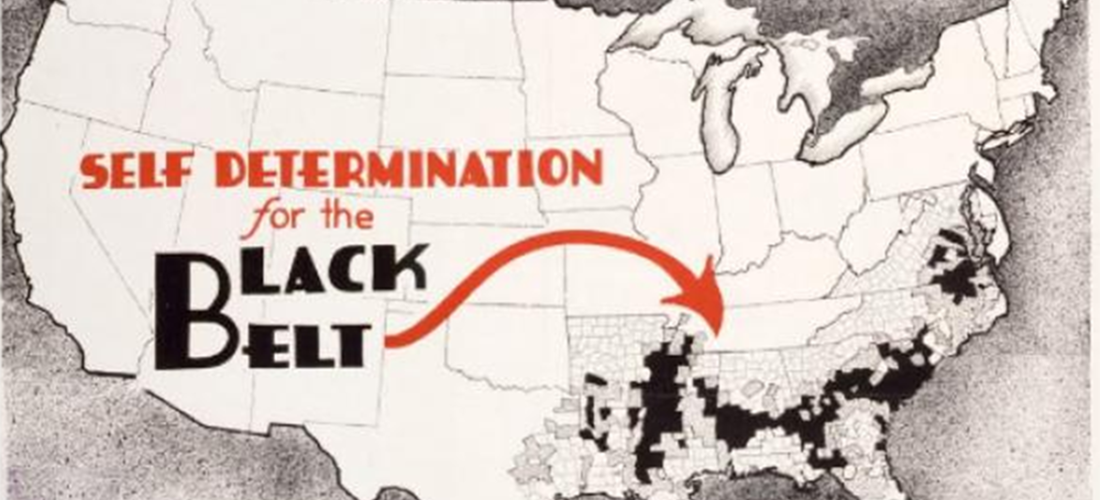
In Defense of the Right to Political Secession for the Afro-American Nation: Papers and Resolutions from the School on the Afro-American National Question (1982)

1946-1989, Black, Date, Defining the Enemy, Self Institution, Subjectives of Refusal, Tactics of Disruption, White Supremacy

These excerpts primarily discuss the Marxist-Leninist perspective on the “Afro-American National Question,” arguing that Afro-Americans in the Black Belt region of the Southern U.S. constitute an oppressed nation with the right to self-determination, including the right to secede and form an independent state. In addition to promoting the right to political secession, the text champions the struggle against white chauvinism as another crucial element for a genuine proletarian revolution in the United States, asserting that this fight is essential for international proletarian solidarity.

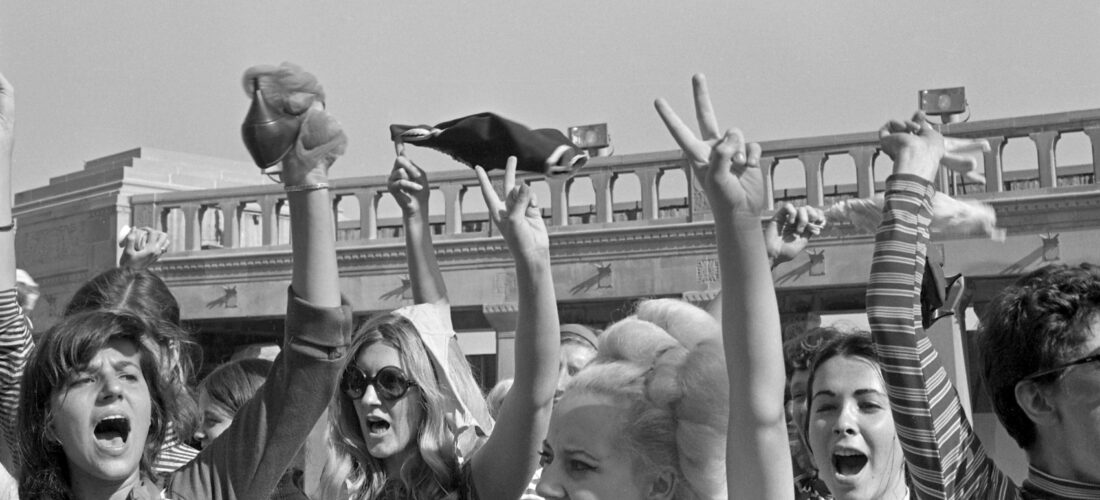
No More Miss America (1968)

1946-1989, Date, Defining the Enemy, Patriarchy, Sabotage/Ecotage, Subjectives of Refusal, Tactics of Disruption, Women

On September 7, 1968, a coalition of women’s liberation groups planned various demonstrations against the annual Miss America Pageant in Atlantic City. These demonstrations aimed to challenge the pageant’s objectification of women through beauty standards, its historical exclusion of women of color, and its role as a symbol of militarism and consumerism. Some direct actions discussed in the source included picket lines, guerrilla theater, and a symbolic “Freedom Trash Can” to discard items representing restrictive feminine ideals, culminating in a boycott of pageant-related products and a rally. The source also contains a ten-point protest statement, outlining the group’s grievances against the Miss America pageant and its effects.

In Defense of the Right to Free Speech and Peaceful Protest on University Campuses – American Association of University Professors (2024)

2011-Present, Authority, Date, Defining the Enemy, Disruptive Spaces, Institutions, The Bourgeoisie

On April 29, 2024, the American Association of University Professors (AAUP) released a statement defending the right to free speech and peaceful protest on college campuses, condemning the militarized response to these forms of student activism, expressing solidarity with all AAUP chapters and members nationwide who have supported these student groups, and calling on others to sign the statement.

Trail of Broken Treaties 20-Point Position Paper – American Indian Movement and Rosebud Sioux (1972)

1946-1989, Blockade/Barricade, Date, Defining the Enemy, Disruptive Spaces, Imperialism, Indigenous, Institutions, Occupation, Subjectives of Refusal, Tactics of Disruption, Urban Spaces, White Supremacy

In 1972, AIM activists and members of the Rosebud Sioux organized the Trail of Broken Treaties and Pan American Native Quest for Justice. This demonstration brought caravans of Native Americans from across the country to Washington D.C. where they occupied the Bureau of Indian Affairs (BIA) for six days. The group drafted a 20-point position paper that outlined major issues that needed to be addressed. All of their points centered around recognizing Native American sovereignty and restoring Indigenous rights, as set forth in previous treaties. Additionally, the paper called for the abolishment of the BIA and the creation of an Office of Federal Indian Relations and Community Reconstruction instead.

The Manukan Declaration (2004)

1990-2010, Date, Disruptive Spaces, Indigenous, Subjectives of Refusal, The 'Natural World', Women

The Manukan Declaration was signed by seventeen different organizations across North America, South America, Asia, and Africa that make up the Indigenous Women’s Biodiversity Network in 2004. Generally, it advocates for indigenous voices. It highlights the importance of indigenous women in particular to indigenous culture, tradition, and environmental biodiversity.

“As Indigenous women, we have a fundamental role in environmental conservation and preservation throughout the history of our Peoples. We are the guardians of Indigenous knowledge and it is our main responsibility to protect and perpetuate this knowledge. Our weavings, music, songs, costumes, and our knowledge of agriculture, hunting or fishing are all examples of some of our contributions to the world. We are daughters of Mother Earth and to her we are obliged. Our ceremonies recognize her and we return to her the placentas of our children. She also safeguards the remains of our ancestors.”

The Discovery of What it Means to be American – James Baldwin (1961)

1946-1989, Black, Date, Subjectives of Refusal

In these essays written during his time in Paris, Baldwin reflects on his efforts to find and build relationships around his unique identity as an individual, rather than his identity as an African American, or even the son of slaves. Baldwin speaks of a reconciliation he was able to come to in Europe, as a result of the lack of “social paranoia” that exists in the United States. This reconciliation was apparently one that helped him come to terms with his identity as it was defined in the United States in a way that released him from the illusion of thinking he hated the United States.

Miss America Protest Songs

1946-1989, Consciousness Raising, Date, Defining the Enemy, Disruptive Spaces, Institutions, Patriarchy, Subjectives of Refusal, Tactics of Disruption, Women

The 1968 protest against the Miss America Pageant utilized many disruption tactics, the most well-known of which was a “Freedom Trash Can” used for burning items that the protestors deemed as oppressive to women. Another tactic used was that of chanting and songs performed during the actual pageant, disrupting the event as it went on. Below is a series of original songs composed by the protestors for the pageant.

Slavery Exists! Miss America is a Slave to:

1946-1989, Date, Defining the Enemy, Disruptive Spaces, Institutions, Patriarchy, Subjectives of Refusal, Women

In 1968, 200 feminist activists protested at the Miss America Pageant, symbolically trashing items that enabled domination of women, such as bras, hairspray, makeup, girdles, corsets, and more. The protestors saw the pageant as a mechanism for perpetuating the ideal female, who was subject to unachievable and oppressive standards set by men. The poster below was used to publicize the event and the motivations behind it.

Scenes of Subjection: Terror, Slavery, and Self-Making in Nineteenth-Century America (excerpt) by Saidiya Hartman (1997)

1990-2010, Date, History/Theory, Theory, White Supremacy

This excerpt explains Hartman’s thesis on the omnipresence of terror experienced by enslaved people.

What else could jigs danced in command performance be but the gentle indices of domination?