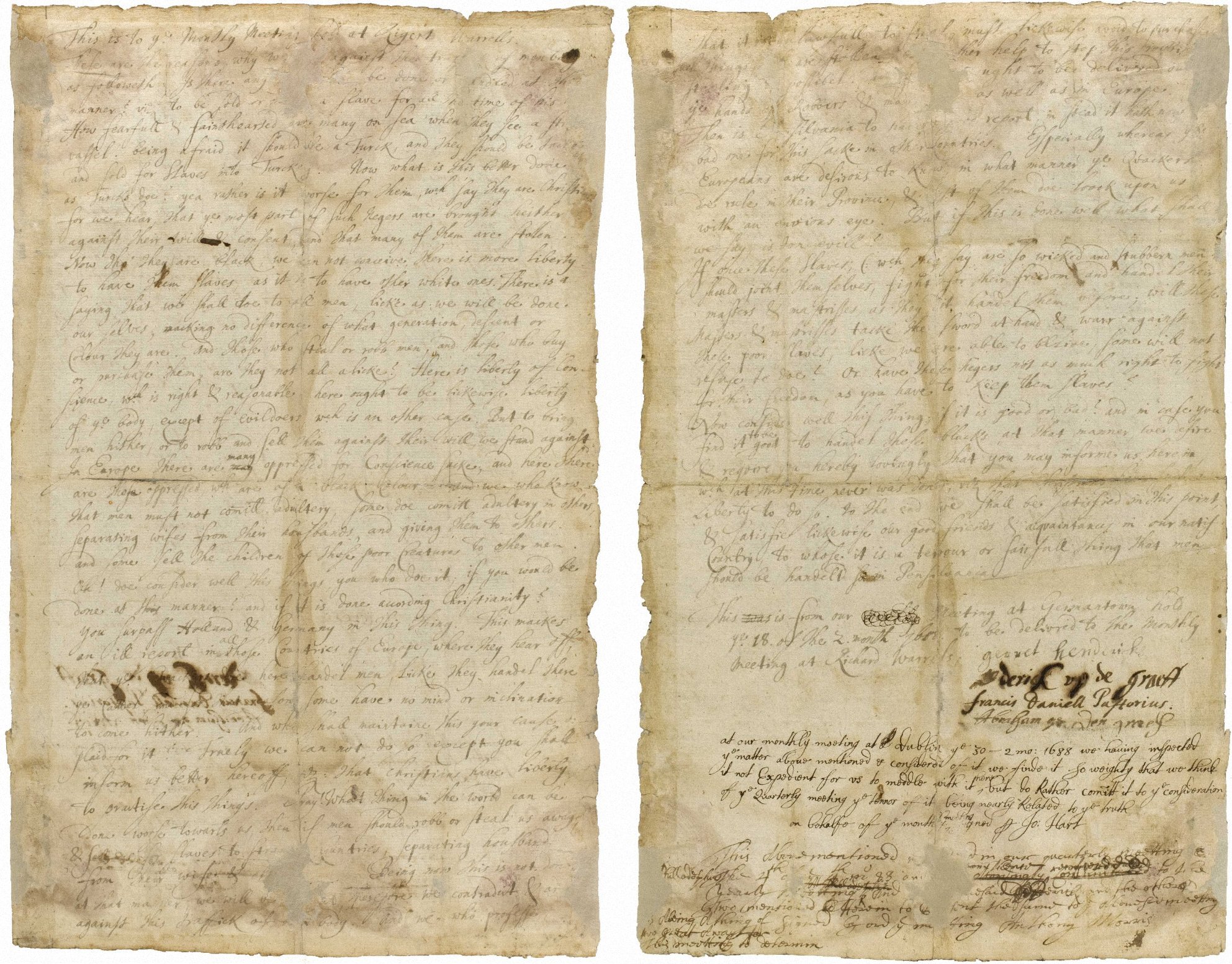
Germantown Quaker Petition Against Slavery (1688)

Authority, Black, Consciousness Raising, Date, Defining the Enemy, Disruptive Spaces, Institutions, Pre-Modern, Subjectives of Refusal, Tactics of Disruption, White Supremacy

This petition served as the first official written protest of slavery in the new world. While it is not a direct rebellion, or call for physical action, the petition and German Quaker organization critiqued slavery for its moral violations of Christian ethics. More accurately, this petiton can be viewed as a call for collective reflection rather than collective action on the issue of slavery in British North America. Because it was only passed along through Quaker governing bodies, this document failed to bring about much driect or disruptive action. It did however, set quite the precedent for future abolitionist movements. While the immorality argument against slavery seems to be a common theme in abolitionist movements now, this petition was the first time morality was utilized to spark a change in social structure.
The U.S. Imperialist State and the Black Nation – Saladine Muhammad (n.d.)

Defining the Enemy, Imperialism, Self Institution, Tactics of Disruption, White Supremacy

This pamphlet, published by The Institute of Black Political Studies, presents a Black scientific socialist perspective on the nature of U.S. imperialism and the struggle for Black national liberation. It argues that the U.S. is a settler-colonial-capitalist system where Black people constitute a domestic colonized nation, facing dual oppression economically, politically, and intellectually compared to the white working class. Ultimately, it advocates for a revolutionary Black nationalist party guided by scientific socialism to lead the national liberation struggle and form strategic alliances with other anti-imperialist movements globally.