The Yellow Jacket Movement: France 2018

2011-Present, Authority, Blockade/Barricade, Consciousness Raising, Date, Defining the Enemy, Disruptive Spaces, Institutions, Privatization, Students, Subjectives of Refusal, Tactics of Disruption, The Workplace, Urban Spaces, Women, Workers

Nothing in the French government anticipated what happened on November 17, 2018. Truck drivers, nurses, store owners, retirees, and farmers were among the hundreds of thousands of common people who put on their bright yellow high-visibility jackets and ventured out into the streets. Roundabouts were blocked. They marched along the Champs-Élysées carrying hand-painted signs that read, “We can’t live like this anymore,” in a dozen different ways. The movement was incredibly unique because it lacked a leader and unity as it began as shared anger on social media. This then spread to a petition against a carbon fuel tax launched by a small cosmetics company owner, Priscilla Ludovsky, which then exploded into French streets when people realized they were not alone. The movement’s chaos was rooted in its lack of a leader, part of its genius that allowed people from the far left and far right to march side by side. The shared experience of the rising cost of living with stagnat wages inoted rural workers with suburban business owners in the fight against the contemotuous government. The jacket worn by protestors also became symbolic; every driver in France is legally required to keep one in their car (they cost practically nothing), and when worn in protest it turned an entire nation of ordinary people into a very visible unified force that could not be dismissed.

What triggered the movement was President Emmanuel Macron’s fuel tax increase, a carbon levy framed as environmental policy but inevitably another cost pushed onto people who could least afford it: those in rural areas without access to public transport. The irony was that the president had abolished France’s wealth tax on the right, now taxing the diesel tank of the single mother driving 45 minutes to her minimum wage job. The demands that emerged went well beyond fuel. The people urged for the reinstatement of the solidarity wealth tax Macron had scrapped, a higher minimum wage, proportional representation in parliament, and a new democratic mechanism called the référendum d’initiative citoyenne, a citizens’ initiative that would give ordinary people direct legislative power.

These protest sites were met with armed riot police with flash-ball launchers and string-ball grenades. During the duration of the protests, around 27,000 people were injured, including around 2,000 police officers. 12,000 civilians were arrested, with close to 400 imprisoned. The protests did lead to Macron cancelling the fuel tax increases that triggered the movement, then launching a national consultation process, which dispersed billions in wage concessions, forcing him to acknowledge the gap between the French governing body and ordinary workers. The movement’s cultural and political legacy forced the question of economic inequality, asking for whom the system is actually built. Priscilla Ludovsky, the woman credited for launching the original petition, went from small business owner to training for political office, leading many Yellow Vesit representative to run in municipal elections. For the duration of a year-long movement, protesters showed in high-visibility vests to say: we see the system clearly now, and we refuse to accept it. A jacket that costs ten euros, worn by millions, that made a government cancel its policies and a president spend years trying to explain himself.

Sonthonax Abolition of Slavery (1794)

1700-1830s, Consciousness Raising, Date, Privatization, Self Institution, Tactics of Disruption, The Workplace

On August 29, 1793, Léger-Félicité Sonthonax, civil commissioner of the northern part of the French colony Saint-Domingue (present-day Haiti), issued a decree that formally abolished slavery forever in his region of the colony. This proclamation, which was seemingly the first of its kind, created a snowball effect that eventually led to the National Convention’s official Feb 4, 1794, decree abolishing slavery throughout all of the French colonies. Used initially as a tactic for securing the colony for French control in the face of British invasion and colony-wide slave revolt, Sonthonax can easily be credited with paving the way for early calls for the abolition of slavery, and was a primary initiator for the French being one of the first countries to formally abolish the institution of slavery throughout all of their provinces and colonies. What began as a “small” political action in the northern region of a colony with a very large slave population established one of the most disruptive chains of events for the abolition of the institution of slavery.

“A cop sleeps inside each one of us. We must kill him.” The graffiti of the French May 1968 Uprising

1946-1989, Authority, Date, Defining the Enemy, Disruptive Spaces, Institutions, Students, Subjectives of Refusal, Urban Spaces, Workers

A collection of slogans spray-painted on the walls and halls of Paris in May 1968.

In the decor of the spectacle, the eye meets only things and their prices. 
We will ask nothing. We will demand nothing. We will take, occupy. 
Barricades close the streets but open the way. 
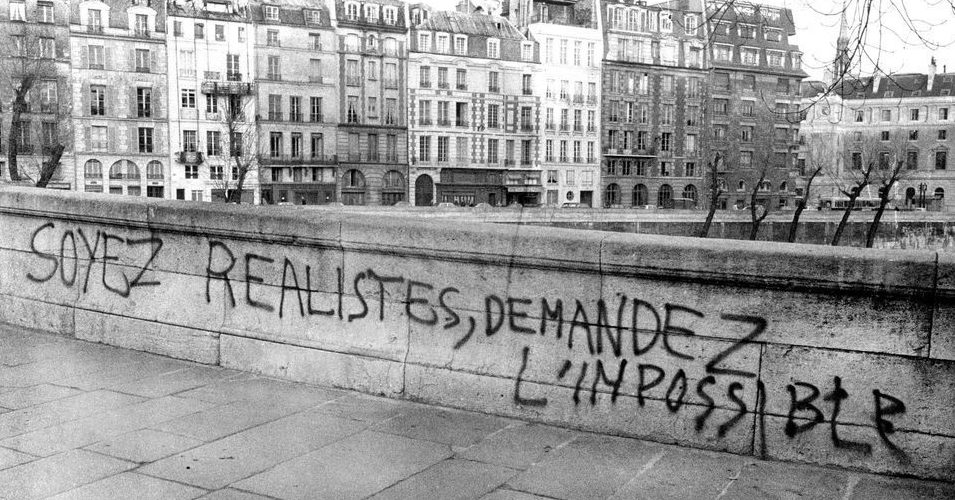
Be Realistic, Demand the Impossible
The Coming Insurrection – The Invisible Committee (2009)

1990-2010, Alternative Spaces, Authority, Blockade/Barricade, Date, Defining the Enemy, Disruptive Spaces, History/Theory, Imperialism, Infrastructure/Data, Institutions, Occupation, Privatization, Sabotage/Ecotage, Self Institution, Subjectives of Refusal, Subjects Redefined, Tactics of Disruption, The Bourgeoisie, The Workplace, Theory, Time Interrupted, Workers

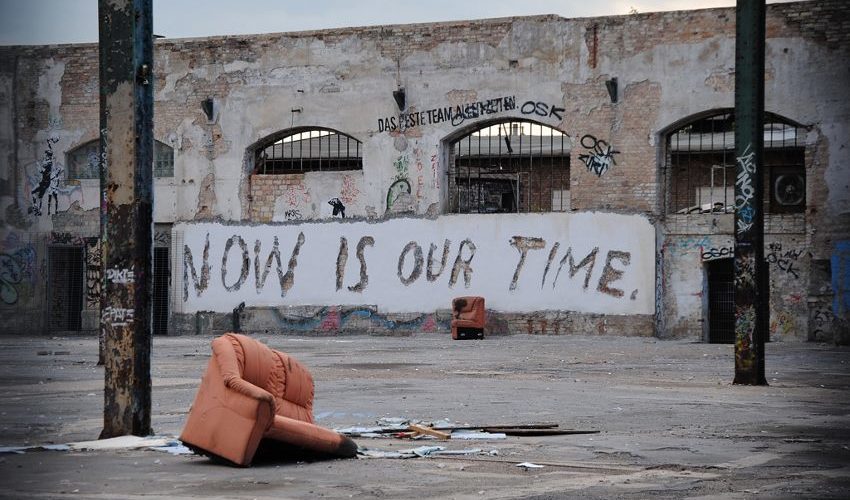
Now classic text by French collective – The Invisible Committee describing the present impasse through seven circles of hell and the way out through the insurrectionary commune.

The goal of any insurrection is to become irreversible.
It becomes irreversible when you’ve defeated
both authority and the need for authority, property
and the taste for appropriation, hegemony and the
desire for hegemony. That is why the insurrectionary
process carries within itself the form of its victory, or
that of its defeat. Destruction has never been enough
to make things irreversible. What matters is how it’s
done. There are ways of destroying that unfailingly
provoke the return of what has been crushed.

How To (Safely) Stop A Train – Bure Polit-Art Collective (2019)

2011-Present, Blockade/Barricade, Date, Disruptive Spaces, Infrastructure/Data, Sabotage/Ecotage, Tactics of Disruption, The 'Natural World'

Step-by-step manual on safety, sabotage, and blockades of rail infrastructure from France.

“The interruption of electricity, goods or data streams with the aim of disturbing the functioning of capitalist logic or the infrastructure of the ruling order has always been a form of resistance.” We hope this reading can be helpful as a “spark of inspiration” for your very personal blockade and sabotage experiences.”