Aihwa Ong’s “State Versus Islam: Malay Families, Women’s Bodies and the Body Politic in Malaysia” (1987)

1946-1989, Date, Subjectives of Refusal, Women

Ong describes the emerging disruption from the growing tension between Islamic revivalism and the Malaysian state’s modernization project in this essay. This disruption is the most clear in daily family life and in the regulation of women’s bodies, where new moral expectations challenge the previously flexible Malay social practices. As Islamic movements seek to impose stricter codes of dress, sexuality, and gender behavior, women become symbolic sites through which broader concerns around national identity, modernity, and religious authority are negotiated. The resulting disruption does not produce social collapse, but a reorganization of power, as both the state and Islamic institutions extend their control over intimate aspects of life. Ong frames this social disruption as a contested process that reshapes norms, identities, and governance in Malaysia, revealing how gender becomes central to managing social change.

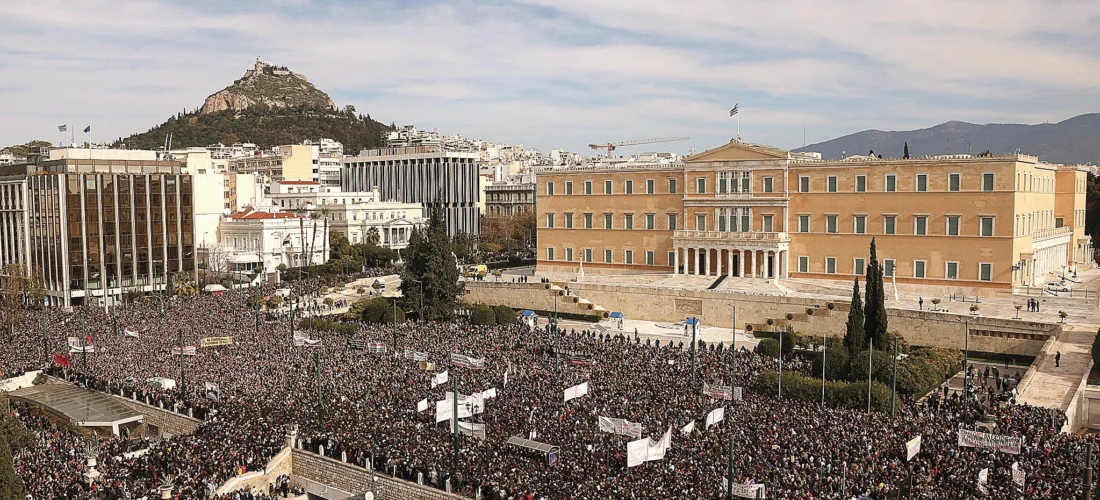
Syntagma Square Assemblies

2011-Present, Authority, Blockade/Barricade, Defining the Enemy, Disruptive Spaces, Institutions, Occupation, Privatization, Strike, Subjectives of Refusal, Tactics of Disruption, The Workplace, Uncategorized, Urban Spaces, Workers

In May 2011, the movement of popular assemblies erupted as a disruption to society. Begun through a Facebook call to express indignation, this movement morphed quickly into a mass occupation. This assembly delegitimized the political class, forced general strikes, and disrupted the flow of everyday life in the heart of Athens. Parliamentary access, business, education, baking, and tourism were repeatedly interrupted, affecting the daily lives of people in Greece. The assemblies demanded direct democracy and exposed the divisions between peaceful protesters, anti-authoritarians,and nationalists, increasing tension within the movement, but also increasing difficulty for the state to involve itself. Tens or hundreds of thousands of people formed blockades and attempted to prevent Military Professionals from entering parliament. Protesters rioted, created barricades, improvised medical aid, and played music during tear gas exposure. This movement demonstrated how powerful the combination of unity, perseverance, and protest is, even when disordered and disorganized. This assembly created a political crisis that terrified elites and prompted the reconfiguration of social norms of who can speak and act in the public sphere. Syntagma’s occupations disrupted institutional routine, fractured political legitimacy, and dispersed power to the people through the promises brought through solidarity, popularity, and movement.

https://libcom.org/article/preliminary-notes-towards-account-movement-popular-assemblies-tptg: Syntagma Square Assemblies
Hong Kong 'umbrella movement' marks first anniversary and vows to fight on | Hong Kong | The Guardian

Hong Kong 2014 Umbrella Movement

2011-Present, Authority, Blockade/Barricade, Date, Defining the Enemy, Disruptive Spaces, Institutions, Occupation, Subjectives of Refusal, Tactics of Disruption, Urban Spaces, Workers

“The conflicts between the protesters and the established rulers during the crisis allowed news media to adopt a variety of frames congruent with their political and
social values.”

Y. Roselyn Du

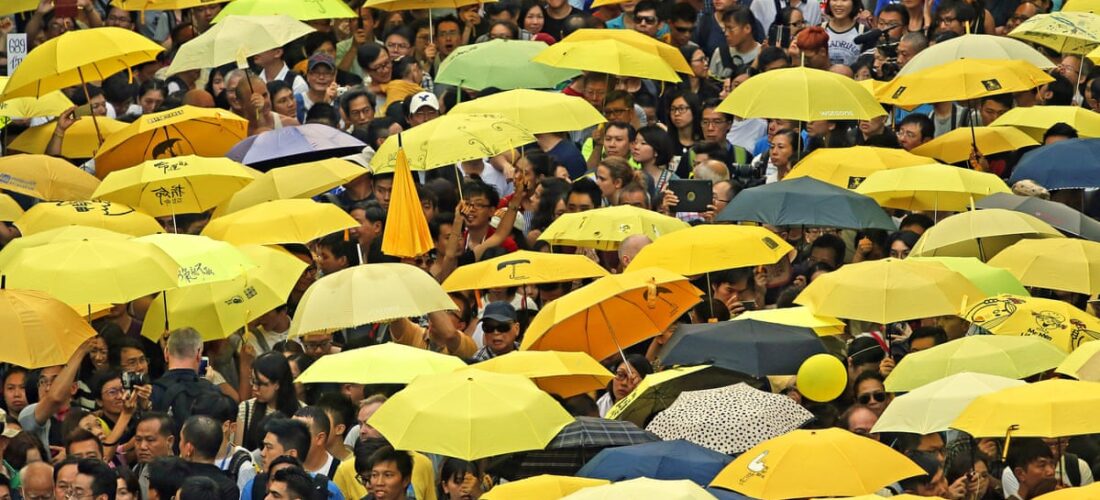
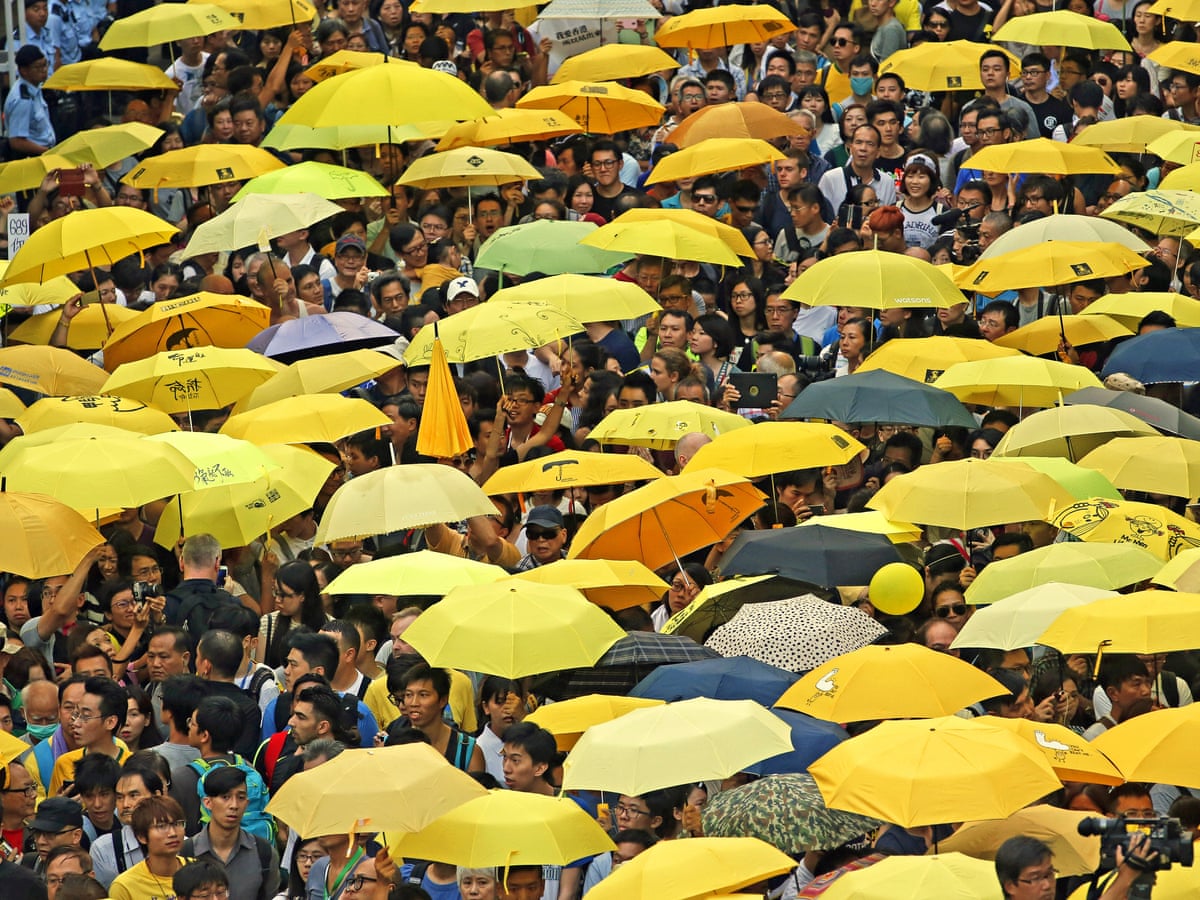
In 2014 in Hong Kong, the Umbrella movement began after Beijing ruled against universal suffrage, prompting tens of thousands of activists to occupy main roads in the city for weeks on end. Protesters built barricades, set up tents, and shut down necessary districts, which disrupted traffic, businesses, and daily life, as well as created huge transportation delays. Police responded with arrests and clearance operations, which increased tension in the city as opposed to restoring order. The yellow umbrellas were used to shield themselves from pepper spray and tear gas, which was politically symbolic as it challenged China’s authority and exposed the deeply rooted divisions within Hong Kong’s society. This also produced polarized media narratives worldwide, with state-controlled media portraying the protests as chaos, while Western outlets framed the protests as promoting democracy. This document is a journal article describing the divide in media coverage from different regions and how this framing creates different interpretations of the occupation.

Ania Loomba’s “Dead Women Tell No Tales”

1990-2010, Colonized, Date, Defining the Enemy, Imperialism, Patriarchy, Subjectives of Refusal, Women

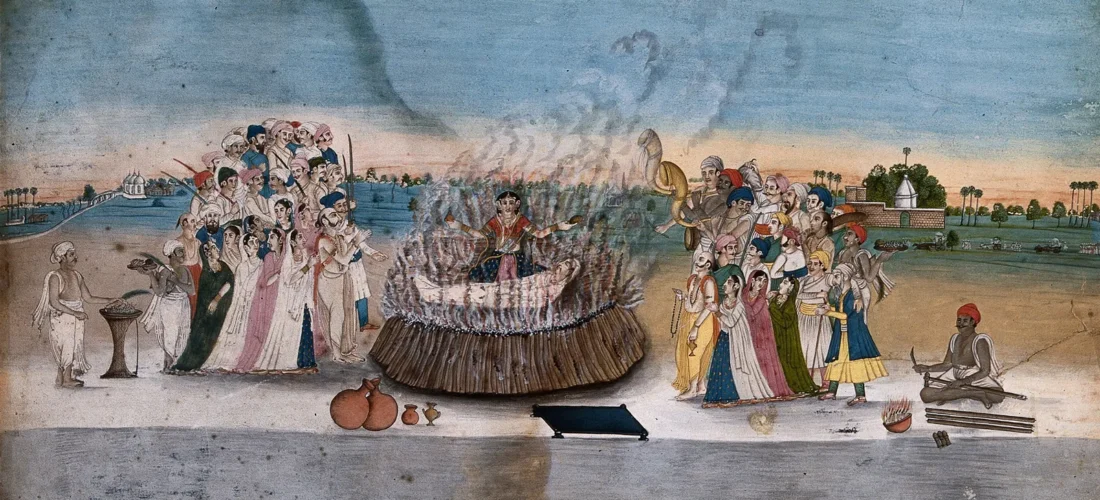
Loomba’s essay traces how the sati-widow has been represented from the colonial period through postcolonial debates. Sati is a historical Hindu practice in which a widow is burned alive on her deceased husband’s funeral pyre, either voluntarily or by coercion. Loomba explains how the very societal systems that have attempted to define her—colonial, patriarchal, nationalist, and feminist—are disrupted by the sati-widow figure. Each of these systems relied on the widow as a symbolic figure, but simultaneously erased her subjectivity. This erasure forces a rethinking of these prevailing narratives, proving the instability of the social, cultural, and epistemic frameworks that sought to confine her.

Darkness Before Dawn: Occupy Movements of Bahrain

1990-2010, Authority, Defining the Enemy, Disruptive Spaces, Occupation, Subjectives of Refusal, Tactics of Disruption, Uncategorized, Urban Spaces, Workers

“Every minute of the day, I think about what I need to be doing next to sustain the battle to gain freedom, not just for my husband but for myself and for others. None of us are free. We have been living off the whim of an autocrat who decided our fate with a stroke of the pen.”

– Dr. Ala’a Shehabi

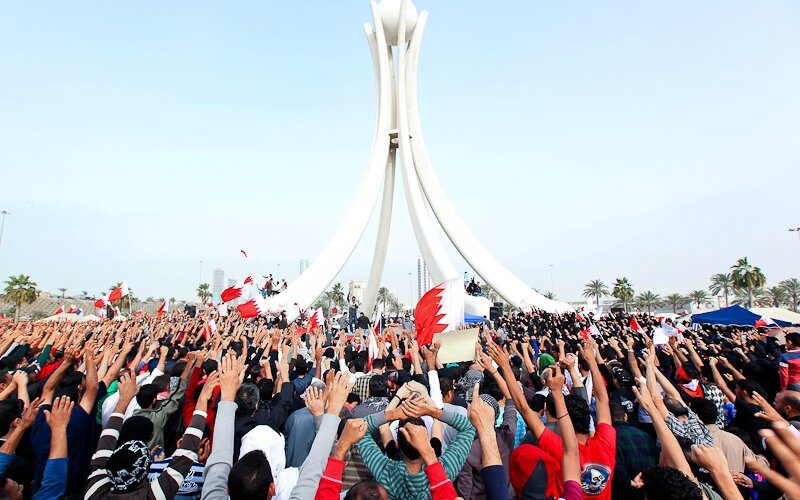
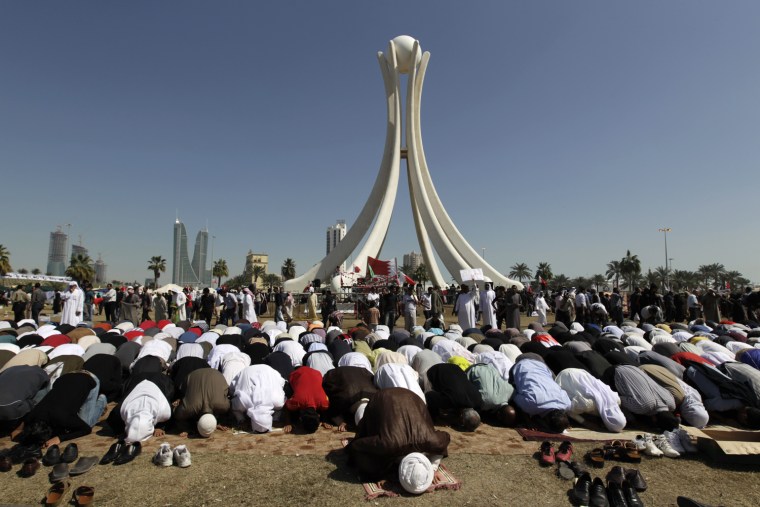
The uprisings in Bahrain were demonstrations that challenged the internal power of the nation as well as its external relations. People gathered in masses at the Pearl Roundabout, with many series of anti-government protests led mainly by the Shia and some Sunni Bahraini opposition. The Pearl Roundabout was initially a symbol of modernization as well as the formation of the GCC, Gulf Cooperation Council; however became more commonly associated with the 2011 democracy protests and was demolished soon after as an attempt to quell the movement as well as its significance. Similar to global Occupy movements, thousands of people occupied this space, showcasing collective resistance and disrupting daily life. The movement threatened the GCC’s commitment to preserving Bahrain’s rule by ordering Saudi Arabia and the United Arab Emirates to deploy troops over the border. In the end, this uprising not only disrupted the authoritarian rule of Bahrain but also the idea that the Arab Spring would not impact nations with substantial oil wealth in the Gulf.

Hawon Jung’s Flowers of Fire (2023)

2011-Present, Defining the Enemy, Patriarchy, Subjectives of Refusal, Women

Hawon Jung draws attention to the personal testimonies and protests that have unfolded in South Korea as a result of persistent gender-based violence. She shows how women’s collective voices have shattered long-standing norms of silence and obedience deeply rooted in the country’s entrenched patriarchy. This activism has challenged not only individuals but also the institutions that have historically protected male authority. The women who participate in this resistance disrupt generational continuity, redefining womanhood in ways that no longer revolve solely around family life and men.

“Wake up! Your Miss Saigon was dead and gone a long time ago. She’s not here anymore.”

Resistance Through No Sex: The 4B Movement in South Korea

2011-Present, Defining the Enemy, Patriarchy, Subjectives of Refusal, Uncategorized, Women

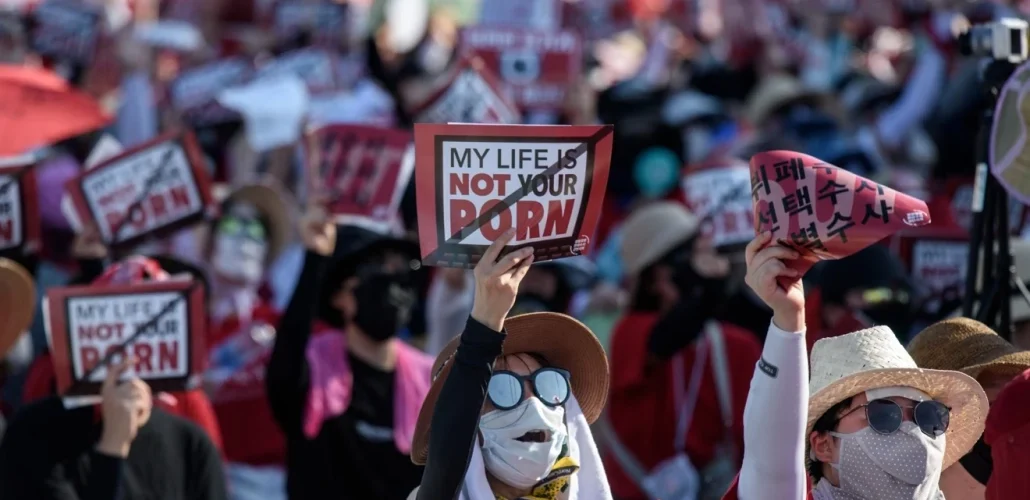
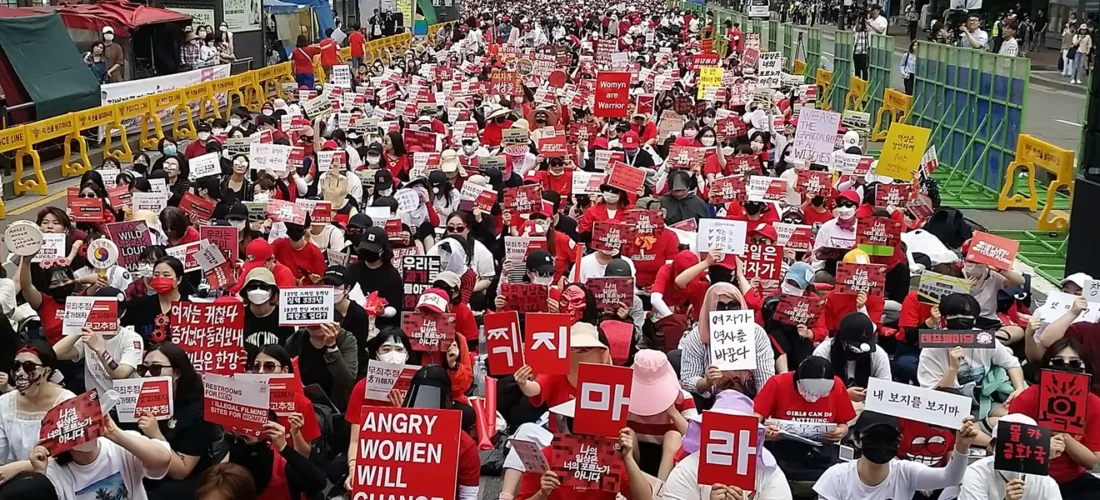
Women in South Korea have continuously been treated as inferior under a deeply ingrained patriarchal system. In 2016, after a young woman was murdered in a misogynistic hate crime, the country reacted with outrage over the poor handling of her case. Misogynistic crimes like this, combined with systemic gender inequality and intense societal pressures, helped spark a collective rejection of men and patriarchal norms. Although often described as a “sex strike,” that is not the sole purpose of the 4B movement. Women in South Korea also place greater emphasis on engaging with and supporting one another rather than conforming to traditional relationships with men.

”The 4B thing is a very Korean, feministic lifestyle, and it is irreversible. We cannot be taken back again!”

Life Without Men: The 4B Movement

2011-Present, Defining the Enemy, Patriarchy, Subjectives of Refusal, Uncategorized, Women

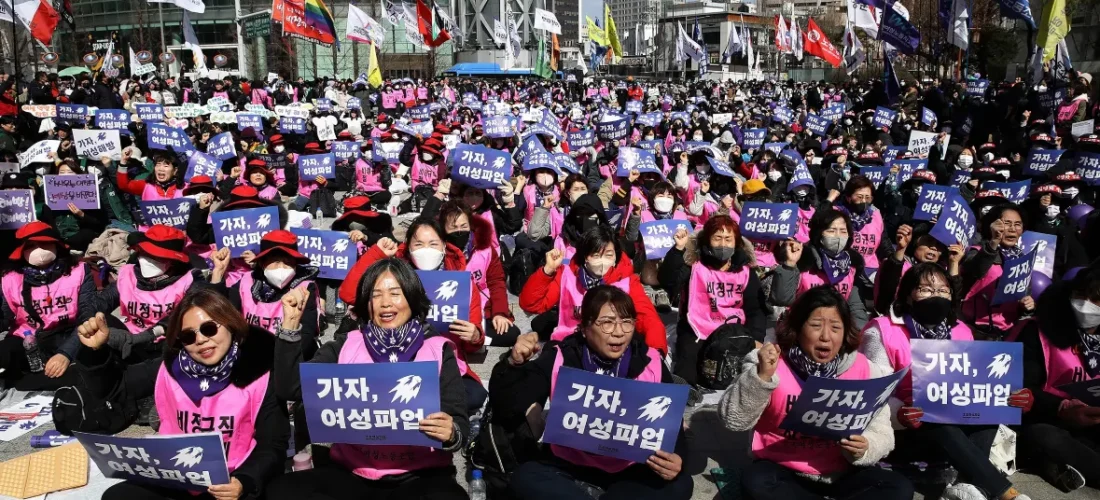
After a history of oppression, rigid gender roles, pervasive misogyny, and gendered violence, many South Korean women have collectively decided to reject traditional patriarchal structures. These women follow the principles of the “4Bs”: bihon (no marriage), bichulsan (no childbirth), biyeonae (no dating men), and bisekseu (no sex with men). Through these rejections, they are not only resisting gender discrimination but also destabilizing societal expectations—with no clear desire to return to traditional roles, even in the aftermath of mass protests. This social disruption has begun to expand westward, reaching beyond Korea’s borders.