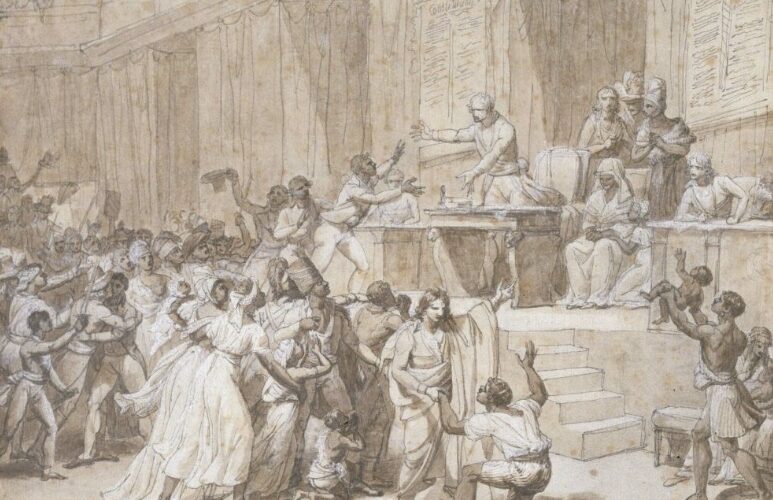
On August 29, 1793, Léger-Félicité Sonthonax, civil commissioner of the northern part of the French colony Saint-Domingue (present-day Haiti), issued a decree that formally abolished slavery forever in his region of the colony. This proclamation, which was seemingly the first of its kind, created a snowball effect that eventually led to the National Convention’s official Feb 4, 1794, decree abolishing slavery throughout all of the French colonies. Used initially as a tactic for securing the colony for French control in the face of British invasion and colony-wide slave revolt, Sonthonax can easily be credited with paving the way for early calls for the abolition of slavery, and was a primary initiator for the French being one of the first countries to formally abolish the institution of slavery throughout all of their provinces and colonies. What began as a “small” political action in the northern region of a colony with a very large slave population established one of the most disruptive chains of events for the abolition of the institution of slavery.
Related Posts:

Mitsubishi Stumped! – NYC Earth First! (1998)
This piece describes the direct actions taken by NYC Earth First! and Wetlands Rainforest Action Group activists at the Mitsubishi International office building. The activists…

The Approaching Obsolescence of Housework: A Working-Class Perspective (1981)
In 1981, Angela Davis Published "Women, Race, and Class". The book analyzes the women's liberation movement through the lens and intersection of racism and classism.…

The Sixties Speak to the Eighties (Redstockings, 1983)
The Redstockings are a radical feminist group that emerged partly out of the Women's Liberation Movement. In this speech, Kathie Sarachild, a prominent activist and…