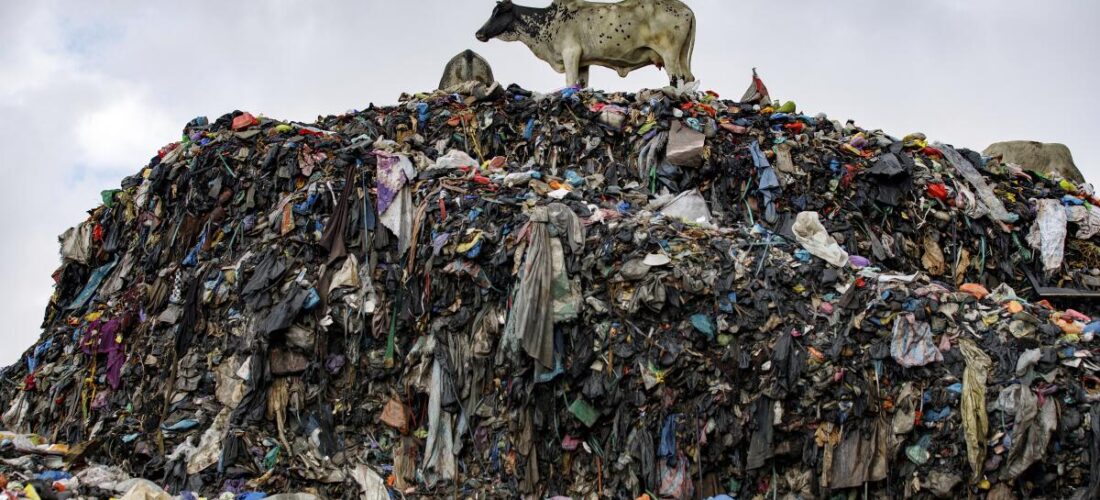
“Around the world, the equivalent of one dump truck filled with clothing is sent to a landfill or incinerator every second.”
Eric Liedtke
Clothing companies produce twice as much clothing today than they did in 2000, and the average American consumer now purchases four times as many clothing items as they did in that same time period. It’s estimated that Americans don’t wear about 50% of the clothing they own, and 65% of the clothing they purchase ends up getting disposed of within 12 months. Because of this, clothing is often exported to Global South Countries, disguised as assistance, sending clothing to countries in need when in reality it causes substantially more harm. The United States sends over 15 million articles of clothing to Ghana a week, ending up in massive secondhand markets like Kantamanto Market in Accra, creating a significant waste crisis as up to half the imported garments are unsellable, clogging landfills, polluting beaches, and overwhelming local waste systems with textile waste, much of it fast fashion that quickly becomes trash. This extreme quantity of unwanted clothing is a disruptive force that restructures everyday life in places like Accra, while the cause (fast fashion companies and exporting companies like the U.S.) creates an environmental catastrophe by forcing this immense burden upon lower-income nations on the other side of the world. Local textile producers and tailors are pushed out of business as secondhand fast fashion floods the market at prices they cannot compete with, eroding domestic industries, productivity, and livelihoods. At the same time, the sheer volume of unsellable garments turns consumption in the Global North into environmental destruction in the Global South, shifting the burden of waste management onto communities with the least infrastructure to absorb it. What appears as excess convenience for American consumers thus becomes economic displacement, ecological degradation, and public health risk elsewhere—revealing overconsumption as a global system of harm rather than an individual choice. The documentary “Buy Now!”, as well as various other environmental sources, exposes the harm of overconsumption, and its parallels to imperialist and colonizing methods specifically in America.
https://www.documentaryarea.com/video/Buy+Now!+The+Shopping+Conspiracy
Related Posts:
The Socialist Labor Party – Declaration of Interdependence (1895)
This document was written by Daniel DeLeon, a prominent leader of the Socialist Labor Party, in 1895. The Socialist Labor Party sought to turn labor…

If A Tree Falls: A Story of the Earth Liberation Front by Marshall Curry (2011)
The Earth Liberation Front (ELF) is the collective name for a group of individual cells that use ecotage to stop the destruction of the environemnt.…
Our Lives are at Stake – Shell Strike (1973)
This pamphlet tells the story of the United States Shell Strike in 1973. It includes descriptions of working conditions, exploitation of workers, and the strike…