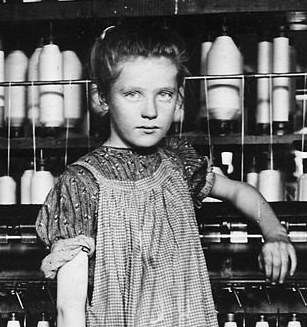
In December 1828, roughly 400 women walked off the looms of the Cocheco Manufacturing Company in Dover, New Hampshire. They marched around the mill quadrangle with banners, signs, and loud, empowering music. The local paper, the Dover Enquirer, responded with contempt, calling the action “one of the most disgusting scenes ever witnessed” and dismissing the workers’ grievances as purely imaginary.
It was the first recorded strike by women in United States history. And it almost didn’t happen at all.
When the Dover Cotton Factory opened in the 1810s under founders John Williams and Isaac Wendell, it operated under a paternalistic but somewhat livable arrangement. Farm girls were recruited from across New Hampshire and southern Maine with promises of good wages, boarding houses, and moral supervision, 10 PM curfews, mandatory church attendance, and an illness fund. Mill work was, briefly, considered a respectable path to financial independence for women who had almost no other routes to it. That shifted dramatically in 1828, when a Boston-installed agent named James Curtis took over. Curtis cut hourly pay from 58 cents a day to 53 cents while simultaneously raising production quotas and increasing loom worker speeds. Workers were paid in company scrip, redeemable only at the factory store, where prices were inflated, and accounts were routinely falsified. Talking on the floor was forbidden. A 12½-cent “lateness” fee was imposed. Joining a union was cause for immediate dismissal. On December 30, 1828, about 400 of the 800 mill girls walked out. The women didn’t slip quietly out the door; they marched, with banners and music, making their dissent visible in a town that had never seen anything like it. The strike failed. The women returned to work three days later, having won nothing. Curtis remained an agent until 1834, when he resigned — not because the workers forced him out, but apparently on his own terms. A second turnout in 1834 also failed.
https://www.dover.nh.gov/government/city-operations/library/research-learn/history/a-yarn-to-follow/: A Yarn to Follow: The Dover Cotton Factory (1812—1821)Related Posts:

The War of the Worlds in France – Kristin Ross (2023)
In the past two years Les Soulèvements de la Terre, a network of ecological activists and groups, has used direct confrontations with polluters and developers…

The Yellow Jacket Movement: France 2018
Hundreds of thousands of ordinary French citizens put on their high-visibility vests as a response to President Emmanuel Macron's fuel tax hike.

Soviet Churches and Schools (1919)
Nikolai Bukharin - a Bolshevik revolutionary - discusses the need for not only economic liberation but also spiritual liberation of the working class and its…