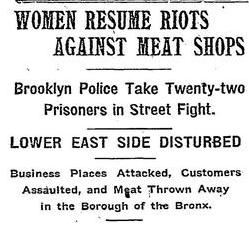
In May 1902, immigrant Jewish housewives in the Lower East Side of New York City launched a boycott, lasting about 3 weeks, against kosher butchery shops in Brooklyn, Harlem, and the Bronx. Triggering this movement was the Beef Trust, a coalition of wholesale butchers that had spiked the prices of kosher meats beyond what was affordable for working-class immigrant families. For these Jewish immigrants, the kosher meats were not a luxury choice but a religious obligation, making the price feel like a direct assault on their community life, making it much more difficult to assimilate smoothly. The boycott was organized by local women from all different boroughs of NYC, most of them being middle-aged mothers working through the difficult social landscape of adapting to life in the U.S. Sarah Edelson and Caroline Schaatzburg were key figures in the protest, as the latter served as president of the Ladies Anti-Beef Trust Association. The wholesale butchers and local leaders tried to hijack the movement and many papers dismissed the whole effort as politically unsophisticated, but the Yiddish press covered the disruption in all seriousness. While the English language socialist papers discredited these women’s efforts, the community, for the most part, backed them. Their deliberate tactics of calling themselves strikers involved ideas of American free speech and leveraged their power over the market. The English press called them animals, but they saw justice.
Related Posts:

Carnival Against Capital? (OWS 2011)
The media wrote it off as a disorganized street party because of the costumes, drums, and even paper-mâché unicorns. Still, in reality, it was a…

The Great Berkeley Rent Strike – Berkeley Tenants Union (1969)
The Berkeley Tenants Union was established in 1969 and sought to organize low-income tenants to join in protest against rent increases, eviction, and poor housing…

Soviet Churches and Schools (1919)
Nikolai Bukharin - a Bolshevik revolutionary - discusses the need for not only economic liberation but also spiritual liberation of the working class and its…