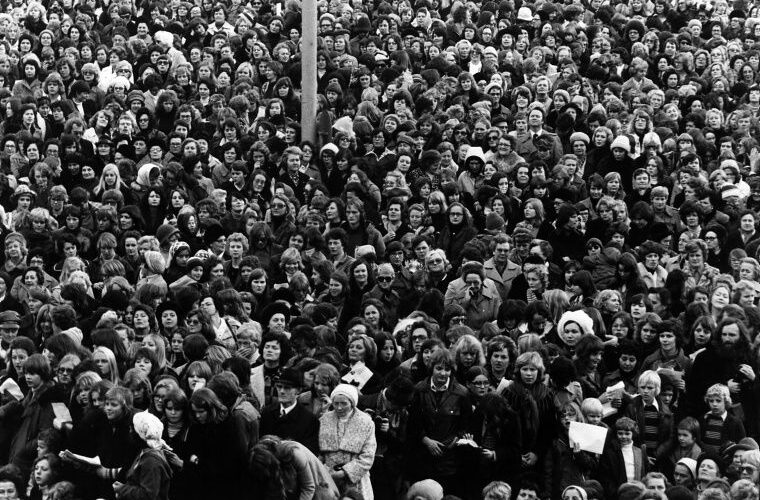
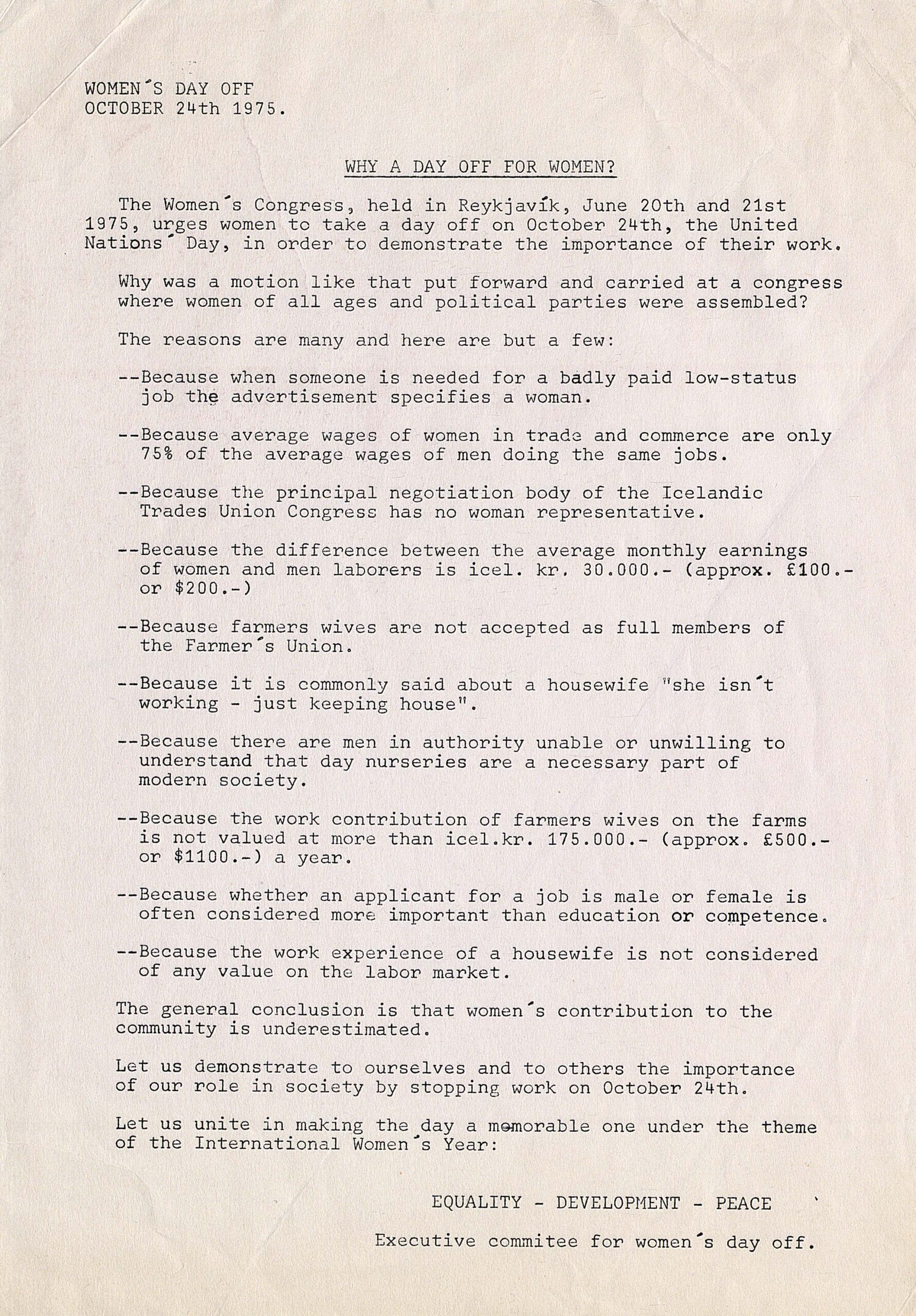
The Women’s Day Off on October 24, 1975 was a monumental moment in Icelandic (women’s) history. The Committee for the Women’s Day Off was founded in June 1975. In March 1976, the Committee gave their Private Papers to the Women’s History Archive along with what was left from their fundraising efforts. Below is an example off the material kept at the archives, a handout from 1975.
95% of Iceland’s women did not go to work. They didn’t cook or clean or look after children. They gathered in town squares and visible public spaces around the nation, with around 25,000 in Reykjavík alone. The collective argument was that the women did work. paid and unpaid, but invisible from the infrastructure that held Icelandic society together, and never acknowledged by society. They called it Kvennafrí. Women’s Day Off. The newspapers called it the Long Friday. By the end of it, the country had a pretty good sense of what women were actually worth.
Women in office and retail work earned roughly 73 percent of what their male counterparts made. Women in manual labor earned 30,000 króna less per month than male workers doing equivalent jobs. Women working on farms — doing the same physical labor as their husbands — were assigned an official annual wage valuation of 175,000 króna, less than a member of parliament earned in a single month. And in industries like fish processing, women and men sometimes worked side by side at the same table doing the same tasks, separated only by their placement in different, lower-paid wage categories.
Beneath this was a structural problem; women were summoned when convenient, and dismissed when not, while being consistently undervalued in all negotiations and bargaining agreements around wages and overtime pay. Women occupied the bottom of every tier of the tiered wage system. Ultimately, sausages, an easily made food, were made available hurriedly and distributed by men around the nation, often referred to as a running joke. The speeches of the rally ranged across unpaid domestic work, wages, international solidarity, and disarmament. They insisted the goal was not to push men aside but to achieve equality and to solve societal problems together. Facts and figures backed their argument, emphasizing how different the world will be when women govern it alongside men, rather than under them.
Related Posts:

Resistance After Galeano’s Murder in the Zapatista Movement
Raheel Hayat’s essay shows that the Zapatista movement emerged stronger after Galeano’s murder by rejecting violence and leader-centered power, instead disrupting state and capitalist efforts…

The Liberator’s Salutation (1831)
The Liberator served as on of the most influential newspapers of the abolitionist movement, and in this "Salutation" by William Lloyd Garrison, we see the…

The Young Lords Party: 13-Point Program and Platform
In a 13-Point Program and Platform, the Young Lords Party declared their fight for self-determination for Puerto Ricans inside and outside the United States.