Self-Management and Hierarchy +1 – Cornelius Castoriadis (1974-6)

1946-1989, Authority, Date, Defining the Enemy, Disruptive Spaces, History/Theory, Privatization, Self Institution, Subjectives of Refusal, Tactics of Disruption, The Bourgeoisie, The Workplace, Theory, Workers

Two articles – Self Management and Hierarchy and The Hungarian Source – by Castoriadis, leading member of the Trotskyite French radical libertarian socialist group Socialisme ou Barbarie that argue for the disruption of workplace hierarchy through worker self-management turning to the often overlooked 1956 Hungarian Uprising as example.

Work: Democratize, Decommodify, Remediate – 2020

2011-Present, Authority, Consciousness Raising, Date, Defining the Enemy, Disruptive Spaces, History/Theory, Privatization, Subjectives of Refusal, Tactics of Disruption, The Bourgeoisie, The Workplace, Theory, Workers

Ferreras, Méda, and Battilana Covid-19 inspired Manifesto subsequently published in 43 Newspapers in 36 countries, calling for a revival of the workers councils, the decommodification of labor, and the disruption of environmental degradation.

To join project or downloading manifesto in 27 other languages go to: https://democratizingwork.org/

“A cop sleeps inside each one of us. We must kill him.” The graffiti of the French May 1968 Uprising

1946-1989, Authority, Date, Defining the Enemy, Disruptive Spaces, Institutions, Students, Subjectives of Refusal, Urban Spaces, Workers

A collection of slogans spray-painted on the walls and halls of Paris in May 1968.

In the decor of the spectacle, the eye meets only things and their prices. 
We will ask nothing. We will demand nothing. We will take, occupy. 
Barricades close the streets but open the way. 
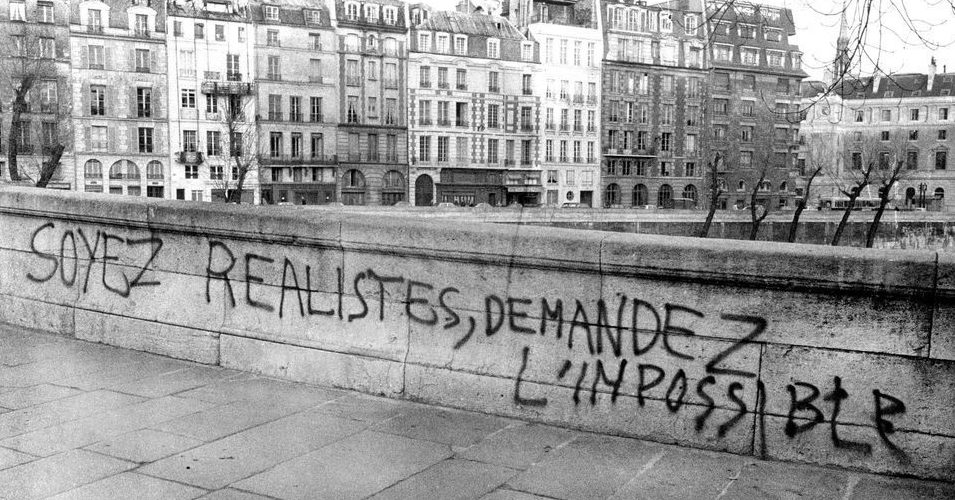
Be Realistic, Demand the Impossible

The Coming Insurrection – The Invisible Committee (2009)

1990-2010, Alternative Spaces, Authority, Blockade/Barricade, Date, Defining the Enemy, Disruptive Spaces, History/Theory, Imperialism, Infrastructure/Data, Institutions, Occupation, Privatization, Sabotage/Ecotage, Self Institution, Subjectives of Refusal, Subjects Redefined, Tactics of Disruption, The Bourgeoisie, The Workplace, Theory, Time Interrupted, Workers

Now classic text by French collective – The Invisible Committee describing the present impasse through seven circles of hell and the way out through the insurrectionary commune.

The goal of any insurrection is to become irreversible.
It becomes irreversible when you’ve defeated
both authority and the need for authority, property
and the taste for appropriation, hegemony and the
desire for hegemony. That is why the insurrectionary
process carries within itself the form of its victory, or
that of its defeat. Destruction has never been enough
to make things irreversible. What matters is how it’s
done. There are ways of destroying that unfailingly
provoke the return of what has been crushed.

Sabotage – I.W.W. Elizabeth Gurley Flynn (1911)

1840-1945, Date, Defining the Enemy, Disruptive Spaces, Sabotage/Ecotage, Subjectives of Refusal, Tactics of Disruption, The Bourgeoisie, The Home, The Workplace, Women, Workers

In which the rebel girl describes various forms of sabotage including limiting the over-supply of workers through contraception


It is my hope that workers will not only ‘sabotage’ the supply of products, but also the over-supply of producers. In Europe they are saying, “We are going to limit the supply of workers on the market. We are not going to have 10, 12, 14 children for the army, the navy, the factory, and the mine.”

The General Strike – I.W.W. ‘Big’ Bill Haywood (1911)

1840-1945, Date, Defining the Enemy, Disruptive Spaces, Strike, Subjectives of Refusal, Tactics of Disruption, The Bourgeoisie, The Workplace, Workers

Speech given by Bill Haywood in New York City on March 16, 1911 and subsequently published by I.W.W. in pamphlet form. Delivered on the 40th anniversary of the Paris Commune, Haywood traces the history of the general strike since 1871, its use as a disruptive tactic, and its relation with the ballot

When anything happens to disturb the profits, what do the capitalists do? They go on strike, don’t they? They withdraw their finances from that particular mill. They close it down because there are no profits to be made there. They don’t care what becomes of the working class. But the working class, on the other hand, has always been taught to take care of the capitalist’s interest in the property. You are always looking after the interest of the capitalist, while a general strike would displace his interest and would put you in possession of it.

We Want to Riot, Not to Work – The Brixton Uprisings (1982)

1946-1989, Authority, Blockade/Barricade, Date, Defining the Enemy, Disruptive Spaces, Subjectives of Refusal, Subjects Redefined, Tactics of Disruption, Urban Spaces, We're Not Paying That, White Supremacy, Workers

A pamphlet giving the day by day account of the 1981 Brixton Uprisings, race tension/solidarity, and theoretical reflections on the rise of the “Impossible Class”. Written at the height of capital restructuring in the UK and articulated with Italian Autonomist flair, Here it is, in two parts.

We are interested less in how the working class suffers unemployment than in how the class becomes recomposed in ways which undermine the discipline of the entire labour market which tries to label us as the “the miserable unemployed” in the first place.

The Social General Strike – Stephan Naft (1905)

Defining the Enemy, Disruptive Spaces, Self Institution, Strike, Subjectives of Refusal, Tactics of Disruption, The Bourgeoisie, The Workplace, Workers

Where Naft (aka Arnold Roller) argues for the social general strike as the weapon come of age for the working class. Countering social democratic critics, Naft argues that the disruptive effects of the general strike would precipitate, if not be, the revolution itself.

The social general strike will completely interrupt production in the whole country, stop communication and consumption for the ruling classes long enough to totally disorganize the capitalistic society; so that after the complete annihilation of the old system, the working people can take possession through its labour unions of all the means of production.

The Social General Strike points to a thorough change of the present system: a social revolution of the world; an entire new reorganization; a demolition of the entire old system of all governments.’

Sabotage – Emile Pouget (1908)

Defining the Enemy, Disruptive Spaces, Sabotage/Ecotage, Subjectives of Refusal, Tactics of Disruption, The Bourgeoisie, The Workplace, Workers

French anarco-syndicalist Pouget‘s classic work on collective Sabotage as a critical disruptive strategy of the working class. The short treatise was influential in popularizing sabotage as a disruptive tactic for workers in Latin Europe and – through the IWW – in the United States.

Sabotage: A pestiferous epidemic, becoming to the body social of capitalism more dangerous and incurable than cancer and syphilis are to the human body